Quick answer
Loading bay repair covers the diagnosis and fixing of faults on dock levellers, dock shelters, bumpers, traffic lights and interlocks, from hydraulic leaks and failed power packs to bent lips, cracked hinges, torn shelter curtains and worn bumpers. Repair visits are chargeable: guide price £145 to £195 ex VAT for attendance and the first hour, with loading bay repairs typically £245 to £2,495 ex VAT.
What loading bay faults do you repair?
We repair the faults that stop a loading bay working or make it unsafe to use. On dock levellers that includes platforms that will not rise, drift down or fail to return to stored position, lips that will not extend or fold, hydraulic oil leaks, noisy or overheating power packs, cracked or worn hinges, bent lips and damaged toe guards. Around the bay we repair shelters with torn curtains or bent frames, inflatable shelters that will not inflate, worn or missing bumpers, faulty traffic lights and interlocks that no longer work.
Loading bays take a lot of punishment: heavy forklifts drive over the leveller hundreds of times a day, trailers reverse into the bumpers and shelters, and weather and debris get into the pit. Most faults are the result of wear or impact rather than manufacturing defects, and many can be fixed in a single visit once the cause is clear.
When is a dock leveller unsafe to use?
Stop using a leveller and isolate it if the platform drops unexpectedly or drifts down under load, the lip does not support itself on the trailer bed, there is a significant hydraulic leak, a hinge or lip pin is visibly cracked or displaced, the toe guards are missing or damaged, or the platform does not return to its stored position level with the dock. Any of these can lead to a forklift falling or a person being trapped.
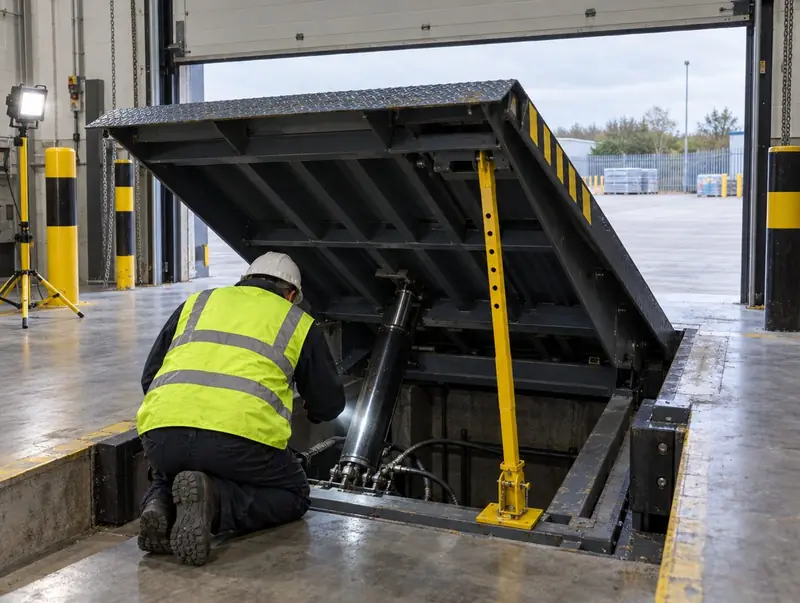
Never work under a raised platform unless it is supported on the maintenance strut, and never try to fix a leveller with the trailer still at the bay. Our engineers make the leveller safe, diagnose the fault and explain what is needed before carrying out chargeable repairs. Regular planned maintenance picks up most of these issues before they become dangerous.
What happens on a loading bay repair visit?
Before the visit, we ask for the leveller and shelter make if known, the symptoms and photographs, so the engineer can bring likely parts such as hoses, seals, control components and bumpers. On site, the engineer isolates the bay, props the leveller on its maintenance strut and inspects the hydraulics, structure, safety devices and controls.
Many repairs are completed on the first visit: hose and seal replacement, control faults, adjustments, toe guard repairs and bumper changes. Larger repairs, such as new lips, hinge rebuilds, power pack replacement or made-to-measure shelter curtains, are quoted at a fixed price before ordering. Repair visits are chargeable at a guide price of £145 to £195 ex VAT for attendance and the first hour, and you receive a written report of findings and work done.
Repair or replace a dock leveller?
Most levellers can be repaired several times during their life. Replacement is worth considering when the platform or frame is cracked or distorted, the pit edges have broken up, hydraulic parts are obsolete, repairs have become frequent, or the leveller no longer suits the vehicles and forklifts now using the bay.
A new leveller can often be fitted into the existing pit, sometimes with re-edging or modification, which keeps disruption down. We price repair and replacement side by side where both are realistic, and our dock levellers page covers the replacement options. If several items at the bay are tired, refurbishing the whole bay at once can be more efficient than a series of separate repairs.
How can you reduce loading bay breakdowns?
Keep bumpers, pits and servicing up to date, because the biggest causes of loading bay damage are impact and neglect. Worn bumpers let trailers hit the leveller lip, shelter and wall; replacing them before they are worn through is one of the cheapest ways to protect a bay. Training drivers and forklift operators in correct use of the leveller, including not driving onto the lip before it rests on the trailer, also reduces damage.
Debris in the pit stops levellers returning properly and damages hinges and hydraulics, so pits should be kept clean. A planned service at least once a year, more often on busy bays, checks hydraulics, hinges, safety devices and controls, and identifies parts that are wearing out. For bumper and wheel guide options, see our bollards and door protection page.
At a glance
- Hydraulics
- Power packs, pumps, cylinders, hoses, seals, valves and oil
- Structure
- Lips, lip hinges, rear hinges, platform plates and pit edges
- Safety
- Toe guards, velocity fuses, maintenance struts and emergency stops
- Controls
- Control panels, push-buttons, automatic return and door interlocks
- Shelters
- Curtains, frames, scissor arms, inflatable bags and blowers
- Bay equipment
- Bumpers, wheel guides, traffic lights, dock lights and vehicle restraints
- Makes
- Most common makes of leveller and shelter, subject to parts availability
Guide prices
| Item | Guide price (ex VAT) |
|---|---|
| Loading bay repair | £245 – £2,495 |
| Repair visit (attendance and first hour) | £145 – £195 |
Guide prices excluding VAT, which is added at the current rate where it applies. The visit price is agreed before we attend, and any repair is quoted before we carry it out.
What we check on a visit
- Leveller make, type and age, and shelter type
- Symptoms: drifting, failure to rise or return, leaks, noises
- Hydraulic power pack, cylinders, hoses and oil condition
- Lip, hinges, platform plates, toe guards and pit edges
- Controls, interlocks, traffic lights and emergency stop
- Bumpers, wheel guides and shelter curtains and frames
Dock leveller and loading bay repairs: frequently asked questions
Do you repair dock levellers you did not install?
Yes. We repair most makes of hydraulic and mechanical dock leveller, whoever fitted them. If parts for an older leveller are no longer made, we look for compatible alternatives, or explain if replacement into the existing pit makes more sense.
Why does our dock leveller drift down?
Drift is usually caused by internal leakage in the hydraulic cylinder or valve, a failing power pack, or low oil from an external leak. It should be investigated promptly, as a platform that does not hold its position can be unsafe under load.
Can shelter curtains be replaced without a new shelter?
Yes. Side and top curtains can usually be replaced on the existing frame. They are made to measure, so we record the frame size and type and quote a fixed price before ordering.
How often should loading bay equipment be serviced?
At least once a year as a minimum, more often on busy bays or where the manufacturer recommends it. Levellers are work equipment, so they must be kept in efficient working order and their safety devices tested.
Areas we cover for dock leveller and loading bay repairs
We cover England, Wales, Scotland and Northern Ireland; islands and remote sites by arrangement. Choose your area for local details and the law that applies there.
England
- Bedfordshire
- Berkshire
- Bristol
- Buckinghamshire
- Cambridgeshire
- Cheshire
- Cornwall
- County Durham
- Cumbria
- Derbyshire
- Devon
- Dorset
- East Riding of Yorkshire
- East Sussex
- Essex
- Gloucestershire
- Greater London
- Greater Manchester
- Hampshire
- Herefordshire
- Hertfordshire
- Isle of Wight
- Kent
- Lancashire
- Leicestershire
- Lincolnshire
- Merseyside
- Norfolk
- North Yorkshire
- Northamptonshire
- Northumberland
- Nottinghamshire
- Oxfordshire
- Rutland
- Shropshire
- Somerset
- South Yorkshire
- Staffordshire
- Suffolk
- Surrey
- Tyne and Wear
- Warwickshire
- West Midlands
- West Sussex
- West Yorkshire
- Wiltshire
- Worcestershire
Wales
Scotland
- Aberdeen and Aberdeenshire
- Angus and Dundee
- Argyll and Bute
- Ayrshire
- Dumfries and Galloway
- Edinburgh and the Lothians
- Fife
- Forth Valley
- Glasgow
- Highlands and Islands
- Lanarkshire
- Perth and Kinross
- Renfrewshire and Dunbartonshire
- Scottish Borders
Northern Ireland
Last updated 19 October 2026.