Quick answer
Sliding and folding industrial doors open sideways instead of upwards. Sliding doors run on a track across the wall face; folding doors split into hinged leaves that concertina to one or both sides. Both suit wide openings, low headroom, agricultural buildings and workshops where nothing can coil or run under the roof. Guide price £5,995 to £24,995 ex VAT, supplied and fitted, depending on size and operation.
When does a sliding or folding door make sense?
A sliding or folding door makes sense when an opening is too wide, too short of headroom or too cluttered overhead for a roller shutter or sectional door. Because the leaves move sideways across the wall, nothing has to coil above the lintel or run back under the roof, and there is no practical limit on width: very wide openings are simply split into more leaves.
That makes them the traditional choice for agricultural buildings, transport yards and vehicle sheds, plant rooms, workshops with overhead cranes, and older buildings with low eaves. They also suit openings used occasionally, where a robust manual door is more sensible than a motor. For the largest spans, such as aircraft hangars, see our hangar and large-span doors.
Sliding or folding: what is the difference?
Sliding doors move flat leaves along a track past the opening, while folding doors hinge their leaves into a stack at the side, so the two solve the same problem differently.
- Sliding doors are one or more flat leaves that slide along a track past the opening. They need clear wall space to the side equal to the width of the leaves they move. Telescopic arrangements stack several leaves on parallel tracks so they need less side space.
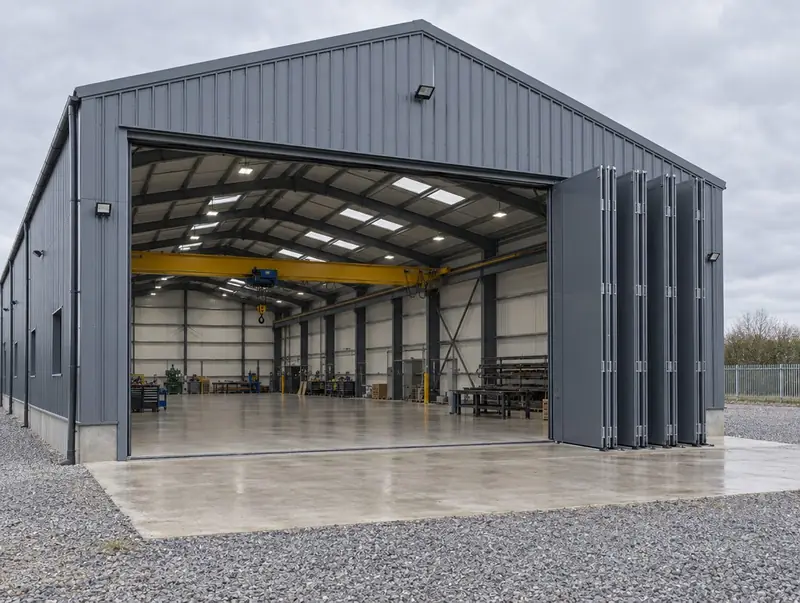
- Folding doors are hinged leaves that fold back against each other like a concertina, either all to one side or split to both sides. They need far less wall space than a sliding door, but the folded stack projects into or out of the building.
On the survey we measure the wall space either side, the projection allowed inside and out and the route vehicles take, then recommend the layout that fits.
Top-hung or bottom-rolling?
Top-hung suits a strong structure and a flush floor; bottom-rolling suits lighter buildings. The choice decides where the weight of the door is carried, and it matters more than most buyers expect.
Top-hung doors hang from trolleys running in an overhead track, with only a guide at floor level. The floor stays almost flush, which suits forklift and pedestrian traffic, but the lintel and wall above the opening must be strong enough to carry the full weight of the leaves. Bottom-rolling doors carry their weight on wheels running on a floor rail, with a guide at the top. They put little load on the structure, which suits older or lightweight buildings, but the floor rail has to be kept clean and protected from damage and debris.
We assess the structure and the floor before recommending either, and where the lintel is not strong enough we price a steel support beam or a free-standing frame. On exposed sites the leaves also need restraint against wind, so we specify top guides, intermediate stops and leaf stiffness to suit the size of the door.
Can sliding and folding doors be automated?
Yes. A drive motor moves the leaves along the track, usually by chain, rack or a driven trolley, with controls from a simple push-button to remotes, induction loops or access control. A powered sliding or folding door creates crushing and shearing points at the closing edges, between leaves and against the wall, so it needs the same care as any other powered door: force limitation, safety edges, photocells and, where people pass close by, guarding.
Automating a door you already have usually makes us its manufacturer in law, responsible for the risk assessment and conformity paperwork. Our guide to converting manual doors to electric sets out what is involved, from the risk assessment to the Declaration of Conformity.
What drives the cost and installation time?
Our guide price for sliding or folding industrial doors is £5,995 to £24,995 ex VAT, supplied and fitted. Width and height set the number and size of leaves; insulated infill, wicket doors, glazing and electric operation add to it, as does any structural steel needed to carry a top-hung track.
A pair of manual sliding doors on a sound structure can be fitted in a day or two; large folding doors, automated doors and anything needing new steelwork take longer. Replacement jobs add strip-out and disposal of the old doors, and bottom-rolling doors may need the floor rail cast or resin-fixed into the slab. You can compare these figures with other door types on our industrial door costs guide.
At a glance
- Door types
- Single or bi-parting sliding, telescopic sliding, and side-folding or bi-folding leaves
- Running gear
- Top-hung on an overhead track, or bottom-rolling on a floor rail with a top guide
- Leaves
- Steel-framed with single-skin or insulated panel infill, or timber-clad for agricultural use
- Pass door
- Wicket door within a leaf, with low-threshold option
- Operation
- Manual with handles and locks, or electric with drive motor and safety devices
- Wind resistance
- Leaf stiffness and guides specified for the size and exposure of the door
- Glazing
- Vision panels or polycarbonate daylight panels on request
Guide prices
| Item | Guide price (ex VAT) |
|---|---|
| Sliding / folding industrial doors | £5,995 – £24,995 |
| Strip-out and disposal on replacement | £345 – £1,195 per door |
Guide prices for supply and installation unless stated, excluding VAT, which is added at the current rate where it applies. Your fixed price is confirmed in writing after a survey, before any work starts.
What we check on the survey
- Opening width and height, and the wall space available either side
- Strength of the lintel or wall head to carry a top-hung track
- Floor condition, level and fall across the opening for a bottom rail
- Projection allowed inside and outside for folded leaves
- Wind exposure and the need for insulation or daylight panels
- Whether electric operation, a wicket door or access control is needed
Sliding and folding industrial doors: frequently asked questions
Are sliding doors suitable for very wide openings?
Yes. Width is where sliding and folding doors come into their own, because the opening is simply split into more leaves. Bi-parting doors, which open from the centre to both sides, halve the distance each leaf travels and the wall space needed on each side.
Can sliding doors be insulated?
Yes. Leaves can be infilled with insulated sandwich panels and fitted with brush or rubber seals along the edges and between leaves. Sliding doors rarely seal as tightly as a sectional door, so for heated buildings we discuss whether an insulated sliding door meets your needs before you commit.
Do sliding doors need much maintenance?
Less than many powered doors, but the running gear still needs attention. Tracks and floor rails must be kept clear, trolleys and wheels checked for wear and lubricated, and guides and stops inspected. Powered sliding doors also need their safety devices tested regularly.
Can you repair old sliding doors on agricultural buildings?
Usually, yes. We replace worn trolleys, wheels, tracks, guides and damaged cladding on most sliding and folding doors. Where the leaves themselves are badly distorted or the track support has failed, replacement may be better value, and we explain the options before quoting.
Areas we cover for sliding and folding industrial doors
We cover England, Wales, Scotland and Northern Ireland; islands and remote sites by arrangement. Choose your area for local details and the law that applies there.
England
- Bedfordshire
- Berkshire
- Bristol
- Buckinghamshire
- Cambridgeshire
- Cheshire
- Cornwall
- County Durham
- Cumbria
- Derbyshire
- Devon
- Dorset
- East Riding of Yorkshire
- East Sussex
- Essex
- Gloucestershire
- Greater London
- Greater Manchester
- Hampshire
- Herefordshire
- Hertfordshire
- Isle of Wight
- Kent
- Lancashire
- Leicestershire
- Lincolnshire
- Merseyside
- Norfolk
- North Yorkshire
- Northamptonshire
- Northumberland
- Nottinghamshire
- Oxfordshire
- Rutland
- Shropshire
- Somerset
- South Yorkshire
- Staffordshire
- Suffolk
- Surrey
- Tyne and Wear
- Warwickshire
- West Midlands
- West Sussex
- West Yorkshire
- Wiltshire
- Worcestershire
Wales
Scotland
- Aberdeen and Aberdeenshire
- Angus and Dundee
- Argyll and Bute
- Ayrshire
- Dumfries and Galloway
- Edinburgh and the Lothians
- Fife
- Forth Valley
- Glasgow
- Highlands and Islands
- Lanarkshire
- Perth and Kinross
- Renfrewshire and Dunbartonshire
- Scottish Borders
Northern Ireland
Last updated 19 October 2026.