
Quick answer
An industrial roller shutter is a door made of interlocking single-skin steel laths that coil onto a barrel above the opening, giving a robust, space-saving closure for warehouses, yards, stores and goods entrances. It can be hand-operated or motorised. Guide price £2,395 to £5,495 ex VAT for an electric single-skin steel shutter up to about 4 × 4 m, supplied and fitted.
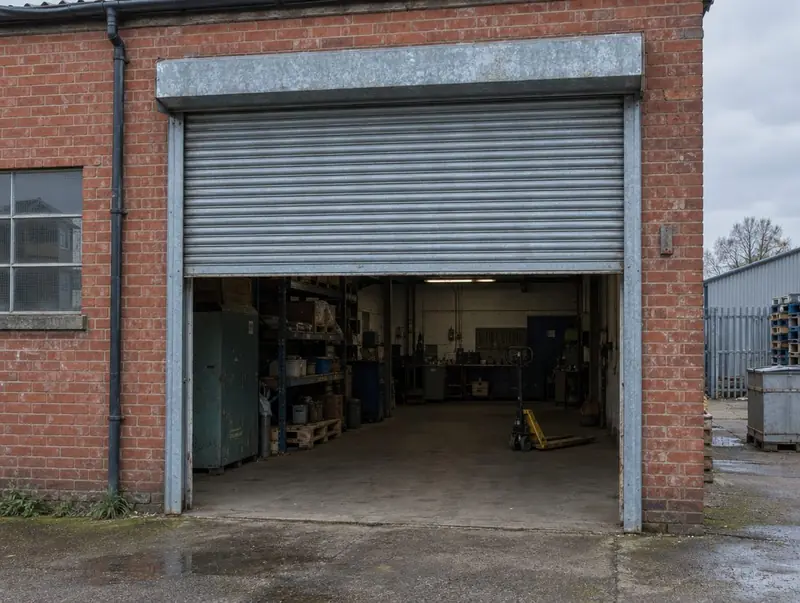
What is an industrial roller shutter?
An industrial roller shutter is a door formed from a curtain of curved steel laths that slot into each other and wind onto a horizontal barrel above the opening. Steel guides fixed to each side of the opening hold the curtain, and a bottom rail stiffens the lowest lath and carries the floor seal.
Single-skin shutters are the simplest and lowest-cost industrial door. They are tough, take up very little room and are quick to install, which is why they are still fitted to yards, stores, bin compounds, unheated warehouses and the fronts of trade units. Where you need to keep heat in, the same format is available with foam-filled laths as an insulated roller door.
Manual or electric — which do you need?
Small shutters can be spring-balanced and pushed up by hand, and mid-sized ones can run on a geared chain hoist. Both are fine for doors opened once or twice a day. As soon as a shutter is used through the shift, a motor pays for itself in time saved and in fewer doors left half-open or forced.
- Tubular motors sit inside the barrel and suit smaller and medium shutters.
- External geared motors, usually direct drive on the end of the barrel or chain drive from a separate motor, handle heavier and wider curtains.
- Manual override by chain or handle lets the door be opened in a power cut.
Converting an existing manual shutter is often possible if the barrel and curtain are sound, and our manual-to-electric conversion guide covers the safety and paperwork that conversion brings with it.
How secure is a roller shutter?
A standard roller shutter deters casual entry and is far stronger than glazing or timber, but it is not a security-rated product. Bottom-rail locks, shoot bolts into the guides and a motor with a brake all make the curtain harder to lift, and a heavier lath gauge resists cutting and denting.
When an insurer or specifier asks for a rating, the shutter itself must be certified, typically to LPS 1175, where the rating combines a threat level and a delay time. That rating belongs to the manufacturer's tested product and only holds if it is installed exactly to the certified specification, including the fixings into the opening. Our guide to industrial door security ratings explains how to read a rating and check the certificate.
Where should the shutter be mounted?
Most industrial shutters are fixed to the inside face of the wall, behind the opening, so the coil and motor are protected from weather and tampering. Where there is no room inside, the shutter can sit within the reveal or on the outside face with a steel hood over the coil. Face-fixed external shutters need care with weather sealing, and the hood keeps rain off the barrel and motor.
On the survey we measure the headroom above the lintel, because the coil diameter grows with door height and lath profile, and we check the side room for guides and the motor. We also look at what the guides will fix to: steel, blockwork, brick and concrete all take different fixings, and a weak or cracked opening may need new steel posts or a steel frame before the shutter goes in.
What does a new roller shutter cost?
Our guide price for an electric single-skin steel shutter up to about 4 × 4 m is £2,395 to £5,495 ex VAT, supplied and fitted. The main variables are size, lath gauge, finish, motor type, controls and safety devices, and whether the shutter is security rated. Removing an old shutter and making good the opening add to the total and are shown as separate lines.
Most single shutters are fitted and commissioned in a day. Powered shutters are tested and handed over with the Declaration of Performance, Declaration of Conformity and user instructions. To keep the warranty valid and the door reliable, book servicing at least once a year, and more often if the shutter cycles heavily, since springs, motors and brakes all wear with use. A service log kept from day one also makes later repairs quicker to diagnose.
At a glance
- Curtain
- Galvanised steel laths, typically 0.7–1.2 mm gauge, with heavier profiles for wide doors
- Finish
- Plain galvanised or powder-coated in a RAL colour
- Operation
- Spring-assisted push-up, chain hoist, or electric motor with manual override
- Mounting
- Behind the opening, in the reveal or on the face of the building, with optional hood
- Vision and airflow
- Perforated or punched vision laths available
- Security
- Bottom-rail locks, shoot bolts; LPS 1175 rated products on request
- Safety
- Safety edge, photocells and anti-fall device on powered shutters
Guide prices
| Item | Guide price (ex VAT) |
|---|---|
| Industrial roller shutter, single-skin steel, electric (to c. 4 × 4 m) | £2,395 – £5,495 |
| Manual-to-electric conversion | £1,195 – £3,195 |
| Strip-out and disposal on replacement | £345 – £1,195 per door |
Guide prices for supply and installation unless stated, excluding VAT, which is added at the current rate where it applies. Your fixed price is confirmed in writing after a survey, before any work starts.
What we check on the survey
- Opening width and height, and the level of the floor at the bottom rail
- Headroom above the lintel for the coil and side room for guides and motor
- Fixing substrate and condition of the opening
- Inside, reveal or face-fixed mounting and the need for a hood
- Power supply position and whether manual operation is enough
- Security requirements from your insurer, if any
Industrial roller shutters: frequently asked questions
How long do industrial roller shutters last?
A well-maintained steel shutter typically gives many years of service. The curtain usually outlasts the moving parts, so motors, springs, end locks and bottom-rail seals are renewed during its life. Regular servicing and keeping vehicles off the guides make the biggest difference to how long a shutter lasts.
Can a roller shutter be fitted outside the building?
Yes. Where there is no space inside, a shutter can be face-fixed outside with a steel hood protecting the coil and motor. External mounting needs good weather sealing and suitable fixings, and we check both on survey before recommending it.
Are perforated shutters available?
Yes. Perforated or punched laths let light and air through and allow a view into the premises while closed, which suits shop fronts, car park entrances and ventilated stores. They offer less weather protection than solid laths, so they are usually fitted where the opening is sheltered.
What happens if the shutter is hit by a vehicle?
A bent guide or damaged laths can stop the shutter running or make it unsafe to operate. Stop using it and get it inspected. Individual laths and guides can often be replaced. Bollards or guide-rail protection fitted afterwards help stop it happening again.
Areas we cover for industrial roller shutters
We cover England, Wales, Scotland and Northern Ireland; islands and remote sites by arrangement. Choose your area for local details and the law that applies there.
England
- Bedfordshire
- Berkshire
- Bristol
- Buckinghamshire
- Cambridgeshire
- Cheshire
- Cornwall
- County Durham
- Cumbria
- Derbyshire
- Devon
- Dorset
- East Riding of Yorkshire
- East Sussex
- Essex
- Gloucestershire
- Greater London
- Greater Manchester
- Hampshire
- Herefordshire
- Hertfordshire
- Isle of Wight
- Kent
- Lancashire
- Leicestershire
- Lincolnshire
- Merseyside
- Norfolk
- North Yorkshire
- Northamptonshire
- Northumberland
- Nottinghamshire
- Oxfordshire
- Rutland
- Shropshire
- Somerset
- South Yorkshire
- Staffordshire
- Suffolk
- Surrey
- Tyne and Wear
- Warwickshire
- West Midlands
- West Sussex
- West Yorkshire
- Wiltshire
- Worcestershire
Wales
Scotland
- Aberdeen and Aberdeenshire
- Angus and Dundee
- Argyll and Bute
- Ayrshire
- Dumfries and Galloway
- Edinburgh and the Lothians
- Fife
- Forth Valley
- Glasgow
- Highlands and Islands
- Lanarkshire
- Perth and Kinross
- Renfrewshire and Dunbartonshire
- Scottish Borders
Northern Ireland
Last updated 19 October 2026.