Quick answer
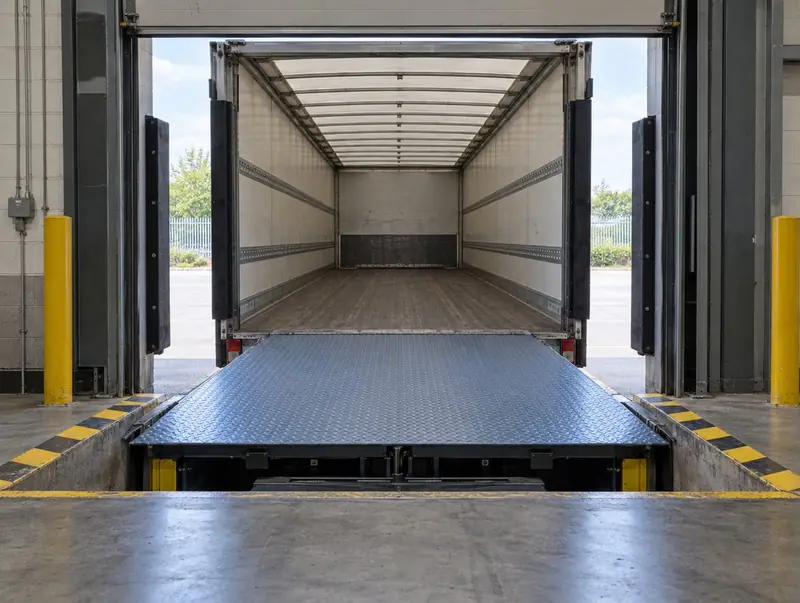
A dock leveller is a powered steel platform set into the edge of a loading dock that raises, lowers and extends a lip onto a trailer bed, creating a safe ramp for forklifts and pallet trucks between dock and vehicle. Hydraulic swing-lip and telescopic-lip types are the most common. Guide prices £6,495 to £10,995 ex VAT for a swing-lip leveller into a prepared pit, and £8,495 to £13,995 for telescopic lip.
What does a dock leveller do?
A dock leveller bridges the height and gap between a loading dock and the bed of a vehicle, so forklifts and pallet trucks can drive straight on and off. Trailer bed heights vary from vehicle to vehicle and change as the suspension compresses during loading, so a fixed ramp or loose plate cannot cope. The leveller's platform tilts up or down to match the bed, and its lip rests on the trailer to close the gap.
Hydraulic levellers are now the standard. At the press of a button a hydraulic cylinder raises the platform, the lip extends or swings out, and the platform lowers until the lip rests on the trailer bed. As the vehicle settles or rises under loading, the platform floats with it. When loading finishes the leveller returns to its stored position, level with the dock floor.
Swing lip or telescopic lip?
The lip type decides how precisely the leveller lands on the trailer and which vehicles it handles well.
- Swing-lip levellers have a hinged lip, typically around 400–500 mm long, that flips out as the platform rises and lands on the bed as it lowers. They are robust, lower cost and suit most standard trailer traffic.
- Telescopic-lip levellers have a lip that slides out under control, typically around 500–1,000 mm, so it can be placed exactly where it is needed. They suit vehicles that park further from the dock, trailers with tail lifts or bulky rear ends, and loads stacked right to the rear of the trailer where a swinging lip would hit them.
Our guide to dock leveller types compares the main designs, including edge-of-dock units for light, occasional use.
How big should the leveller be?
Platform length is set mainly by the height difference it has to bridge. A longer platform gives a gentler slope for the same height difference, which matters because forklifts and especially pallet trucks have limited ground clearance and gradeability. If your fleet ranges from low-bed vans to high-bed trailers, or includes double-deck trailers, the leveller needs to be long enough to keep the slope manageable at both extremes.
Capacity must cover the heaviest laden forklift and load crossing the platform, with an allowance for dynamic forces as it drives on and off. Width usually matches the dock door, typically around 2,000–2,250 mm. We size each leveller after recording your vehicle types, dock height and handling equipment on survey.
What safety features should a dock leveller have?
A dock leveller should have toe guards, a velocity fuse, an emergency stop and a maintenance strut, and modern hydraulic levellers include all of them. Toe guards along the sides of the platform stop feet being trapped as it lowers. A velocity fuse in the hydraulic circuit locks the platform if a hose fails or the trailer pulls away unexpectedly, preventing a sudden drop. An emergency stop on the control panel and a maintenance strut to prop the platform during servicing are standard.
Many sites add an interlock so the leveller can only be operated once the dock door is fully open, and the door cannot close while the leveller is out of its stored position. Vehicle restraints and traffic lights further reduce the risk of a trailer moving away during loading. These measures are most effective when planned with the whole bay; see complete loading bays for how we put them together.
What does installation involve?
On new buildings, levellers are usually supplied as box-frame units that are cast into the dock edge by the groundworks contractor, or fitted into a pit formed to the manufacturer's dimensions. We provide the pit details early so the concrete is right first time. On existing docks, an old leveller is removed and the new one fitted into the existing pit, which may need cutting, repair or new edge steel to suit the new unit.
A single leveller into a prepared pit is typically installed and commissioned in a day. Our guide prices are £6,495 to £10,995 ex VAT for a hydraulic swing-lip leveller into a prepared pit and £8,495 to £13,995 for telescopic lip. Pit forming or modification, bumpers, interlocks and electrical supplies are priced separately where needed.
At a glance
- Types
- Hydraulic swing-lip, hydraulic telescopic-lip, mechanical and edge-of-dock levellers
- Platform size
- Commonly around 2,000–2,250 mm wide and 2,000–3,500 mm long, chosen by height difference
- Swing lip
- Hinged lip, typically around 400–500 mm
- Telescopic lip
- Extending lip, typically around 500–1,000 mm, placed precisely on the trailer
- Capacity
- Rated dynamic loads typically 6,000 kg or more, selected for your forklifts and loads
- Safety
- Toe guards, emergency stop, velocity fuse against sudden platform drop, maintenance strut
- Controls
- Push-button or single-button automatic sequence, with interlock to the dock door
- Installation
- Into a prepared concrete pit, or as a box-frame unit cast into the slab on new builds
Guide prices
| Item | Guide price (ex VAT) |
|---|---|
| Dock leveller, hydraulic swing-lip, into prepared pit | £6,495 – £10,995 |
| Dock leveller, telescopic lip | £8,495 – £13,995 |
Guide prices for supply and installation unless stated, excluding VAT, which is added at the current rate where it applies. Your fixed price is confirmed in writing after a survey, before any work starts.
What we check on the survey
- Dock height and the range of trailer and vehicle bed heights served
- Existing pit dimensions and condition, or new-build pit details
- Forklifts, pallet trucks and the heaviest laden load crossing the platform
- Dock door width and whether an interlock is wanted
- Bumpers, vehicle restraints and traffic lights at the bay
- Power supply to the control panel position
Dock levellers: frequently asked questions
Can a new leveller fit our existing pit?
Often, yes, especially if the new unit is a similar size. Where the pit is a different size, damaged or has corroded edge angles, it may need cutting, repairing or re-edging. We measure the pit on survey and include any work needed in the quote.
How long does a dock leveller last?
With regular servicing, a hydraulic leveller typically gives many years of use. Hinges, lip pins, hydraulic seals, hoses and the power pack are the main wear items. Heavy impacts from vehicles reversing too hard and overloading shorten its life, so bumpers and correct capacity matter.
Do dock levellers need regular servicing?
Yes. They are work equipment, so they must be kept in efficient working order, and a planned service at least once a year is common practice, more often for busy bays. A service covers hydraulics, hinges, lip operation, toe guards, controls and safety devices.
Can a leveller be interlocked with the dock door?
Yes. An interlock between the door and leveller controls means the leveller only operates when the door is fully open and the door cannot close onto a deployed leveller. It is one of the most useful safety upgrades for a busy loading bay.
Areas we cover for dock levellers
We cover England, Wales, Scotland and Northern Ireland; islands and remote sites by arrangement. Choose your area for local details and the law that applies there.
England
- Bedfordshire
- Berkshire
- Bristol
- Buckinghamshire
- Cambridgeshire
- Cheshire
- Cornwall
- County Durham
- Cumbria
- Derbyshire
- Devon
- Dorset
- East Riding of Yorkshire
- East Sussex
- Essex
- Gloucestershire
- Greater London
- Greater Manchester
- Hampshire
- Herefordshire
- Hertfordshire
- Isle of Wight
- Kent
- Lancashire
- Leicestershire
- Lincolnshire
- Merseyside
- Norfolk
- North Yorkshire
- Northamptonshire
- Northumberland
- Nottinghamshire
- Oxfordshire
- Rutland
- Shropshire
- Somerset
- South Yorkshire
- Staffordshire
- Suffolk
- Surrey
- Tyne and Wear
- Warwickshire
- West Midlands
- West Sussex
- West Yorkshire
- Wiltshire
- Worcestershire
Wales
Scotland
- Aberdeen and Aberdeenshire
- Angus and Dundee
- Argyll and Bute
- Ayrshire
- Dumfries and Galloway
- Edinburgh and the Lothians
- Fife
- Forth Valley
- Glasgow
- Highlands and Islands
- Lanarkshire
- Perth and Kinross
- Renfrewshire and Dunbartonshire
- Scottish Borders
Northern Ireland
Last updated 19 October 2026.