Quick answer
Door automation means fitting a motor, control panel and activation devices so an industrial door opens and closes electrically, either at the press of a button or automatically from loops, radar or remotes. It includes converting manual doors to electric and upgrading controls on existing powered doors, with the safety devices and paperwork that a powered door needs. Guide price £1,195 to £3,195 ex VAT for a manual-to-electric conversion.
What does door automation involve?
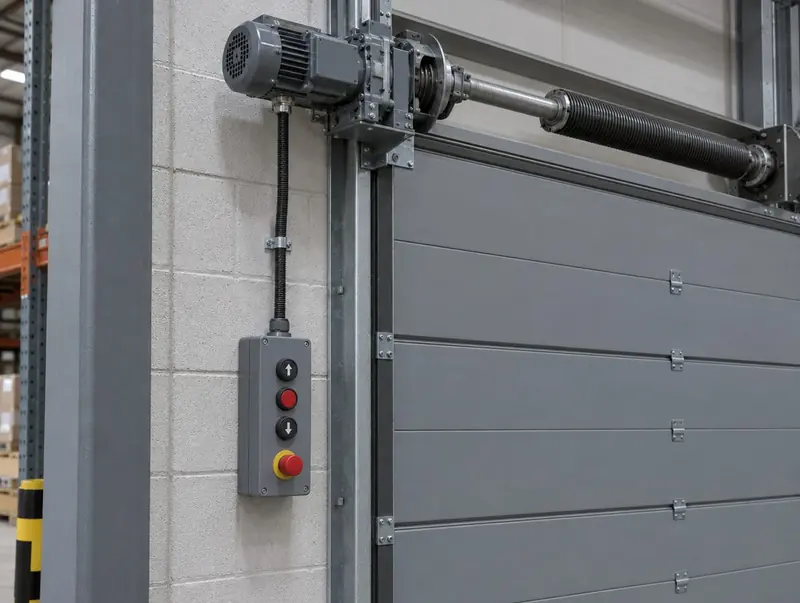
Door automation turns a manually operated door into a powered one, or improves how an existing powered door is controlled. At its simplest, it is a motor matched to the door, a control panel and a push-button station. At its most developed, it is a door that opens as a forklift approaches, closes behind it, refuses to close while anything is in the opening and talks to the dock leveller, the neighbouring door and the fire alarm.
Converting a door to power changes its legal status: it becomes a machine. In Great Britain, whoever converts it usually takes on the manufacturer's duties under the Supply of Machinery (Safety) Regulations 2008, including the risk assessment, technical file, conformity marking, Declaration of Conformity and user instructions. We take on that role for the conversions we carry out. Our manual-to-electric conversion guide explains it step by step.
Which motor suits your door?
The motor must match the door type, weight, size and how often it cycles.
- Direct-drive motors mount straight onto the door's spring shaft or barrel. They are compact and efficient, and are the usual choice for sectional doors and many roller shutters.
- Centre-mounted drives sit in the middle of the shaft or barrel where side room is too tight for an end-mounted motor.
- Chain-drive motors sit on a bracket and drive the shaft or barrel through a chain and sprocket. They suit heavy doors, awkward mounting positions and some older doors.
- Tubular motors sit inside the barrel of smaller roller shutters.
Every motor needs a manual override, by chain hoist or hand crank, so the door can be opened during a power cut. High-cycle doors benefit from a frequency-inverter control panel, which starts and stops the door gently and allows faster opening without extra wear.
How should the door be activated?
The right activation depends on who uses the door and how often. Push-buttons and key switches suit controlled doors used by staff. Radio remotes suit drivers who need to open the door from a vehicle. Pull cords let forklift drivers open a door without getting off. Induction loops cut into the floor detect vehicles but not pedestrians. Radar above the door detects approaching traffic and can be set to ignore passing cross-traffic. Access control links the door to keypads, cards or number plate recognition.
Automatic closing is convenient but raises the safety bar. A door that closes on a timer, with nobody watching, needs reliable detection of anything in the opening, typically photocells or a light curtain together with a safety edge. Our door safety upgrades page explains the main devices.
Can doors be linked to other equipment?
Yes, and linking doors often brings the biggest operational gains. Common interfaces include:
- Airlock interlocks between two doors so only one can be open at a time, keeping clean, chilled or heated areas sealed.
- Door-to-leveller interlocks so a dock leveller can only be deployed when its door is fully open.
- Fire alarm interfaces so selected doors close, or open, when the alarm activates, as the fire strategy requires.
- Traffic lights showing drivers when a door is fully open, and warning beacons that flash while it moves.
- Building management connections that report door status or faults.
Each interface is designed as part of the door's risk assessment and tested at commissioning so the doors behave as expected in every sequence.
What does automation cost?
Our guide price for a manual-to-electric conversion is £1,195 to £3,195 ex VAT, including the motor, control panel, basic controls and commissioning. Inverter drives, loops, radar, traffic lights, interlocks and light curtains add to that, and a safety upgrade on its own is typically £445 to £1,795 per door. A suitable electrical supply to a lockable isolator beside the door is usually provided by your electrician.
Before converting, we check that the door is in good mechanical order: balanced springs, sound cables, straight guides and an intact curtain or panels. A motor does not fix a door that is hard to move by hand, and fitting one to a door in poor condition only accelerates the wear. Where the door is near the end of its life, we price replacement alongside conversion so you can compare.
At a glance
- Drive types
- Direct drive (shaft-mounted), centre-mounted, chain drive, and tubular motors for roller doors
- Control panels
- Hold-to-run, impulse and automatic modes, with frequency-inverter panels for high-cycle doors
- Activation
- Push-buttons, key switches, radio remotes, pull cords, induction loops, radar and access control
- Traffic control
- Red/green traffic lights, warning beacons and sounders
- Interlocks
- Door-to-door airlocks, door-to-leveller and door-to-alarm interfaces
- Safety
- Safety edges, photocells, light curtains and force limits tested to BS EN 12453
- Supply
- Single-phase or three-phase supply to a local lockable isolator
- Paperwork
- Risk assessment, Declaration of Conformity and user instructions on conversions
Guide prices
| Item | Guide price (ex VAT) |
|---|---|
| Manual-to-electric conversion | £1,195 – £3,195 |
| Safety upgrade (edges, photocells, light curtain) | £445 – £1,795 per door |
Guide prices for supply and installation unless stated, excluding VAT, which is added at the current rate where it applies. Your fixed price is confirmed in writing after a survey, before any work starts.
What we check on the survey
- Door type, size, weight and current mechanical condition
- Space for the motor at the shaft end, centre or on a chain bracket
- Daily cycles, users and preferred activation method
- Pedestrian and vehicle routes near the door, for the safety assessment
- Interfaces wanted with other doors, levellers or the fire alarm
- Power supply, phase and isolator position
Door automation and controls: frequently asked questions
Can any manual door be converted to electric?
Most sectional doors, roller shutters and sliding doors can be converted if they are in good mechanical order and suitable motors are available for the make. Doors that are badly worn, unbalanced or damaged need repair first, and sometimes replacement is better value. We assess the door on survey.
Who is responsible for safety after a door is automated?
Whoever converts the door usually becomes its manufacturer in law and must carry out the risk assessment, issue the conformity paperwork and hand over instructions. After handover, the employer or occupier must keep the door maintained and safe to use under workplace and work equipment law.
What happens to an automated door when the power fails?
It can still be opened. Powered industrial doors must be operable manually in a power failure unless they open automatically, so every motor we fit has a manual override such as a chain hoist or hand crank, positioned where staff can reach it.
Can you upgrade the controls on a door that is already electric?
Yes. We replace and upgrade control panels, add remotes, loops, radar, traffic lights and interlocks, and fit inverter drives to existing powered doors, subject to compatibility. Any change to how the door operates is reviewed in its risk assessment.
Areas we cover for door automation and controls
We cover England, Wales, Scotland and Northern Ireland; islands and remote sites by arrangement. Choose your area for local details and the law that applies there.
England
- Bedfordshire
- Berkshire
- Bristol
- Buckinghamshire
- Cambridgeshire
- Cheshire
- Cornwall
- County Durham
- Cumbria
- Derbyshire
- Devon
- Dorset
- East Riding of Yorkshire
- East Sussex
- Essex
- Gloucestershire
- Greater London
- Greater Manchester
- Hampshire
- Herefordshire
- Hertfordshire
- Isle of Wight
- Kent
- Lancashire
- Leicestershire
- Lincolnshire
- Merseyside
- Norfolk
- North Yorkshire
- Northamptonshire
- Northumberland
- Nottinghamshire
- Oxfordshire
- Rutland
- Shropshire
- Somerset
- South Yorkshire
- Staffordshire
- Suffolk
- Surrey
- Tyne and Wear
- Warwickshire
- West Midlands
- West Sussex
- West Yorkshire
- Wiltshire
- Worcestershire
Wales
Scotland
- Aberdeen and Aberdeenshire
- Angus and Dundee
- Argyll and Bute
- Ayrshire
- Dumfries and Galloway
- Edinburgh and the Lothians
- Fife
- Forth Valley
- Glasgow
- Highlands and Islands
- Lanarkshire
- Perth and Kinross
- Renfrewshire and Dunbartonshire
- Scottish Borders
Northern Ireland
Last updated 19 October 2026.