
Quick answer
An insulated roller shutter door is a roller door whose curtain is made of double-skin steel or aluminium laths filled with polyurethane foam, so it coils compactly above the opening but cuts heat loss and noise far better than a single-skin shutter. It suits heated units with limited headroom. Guide price £3,195 to £7,495 ex VAT, electric, supplied and fitted, up to about 4 × 4 m.
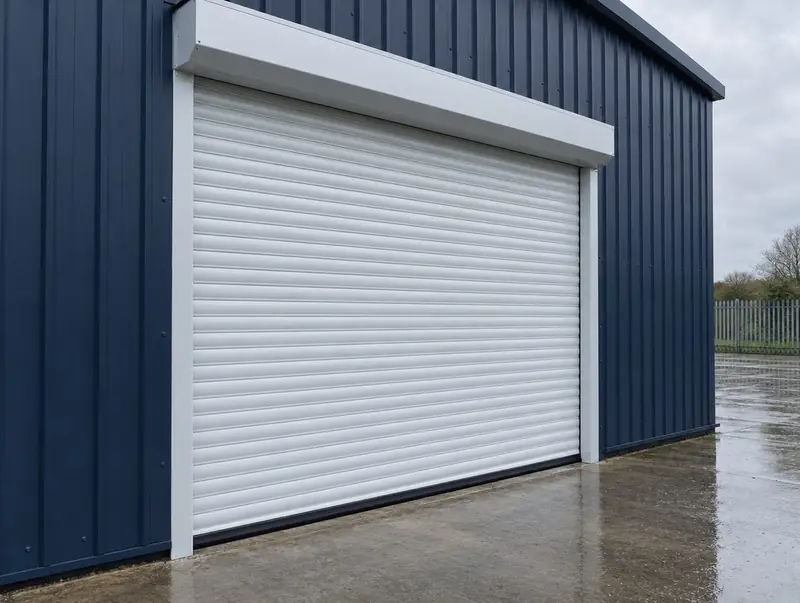
What is an insulated roller shutter door?
An insulated roller shutter door is a door built from interlocking curved laths, each made of two thin metal skins with polyurethane foam injected between them. The curtain winds onto a barrel above the opening, just like a standard roller shutter, but the foam core gives it a thermal and acoustic performance that a single-skin steel curtain cannot match.
Because the curtain coils into a compact roll instead of running back under the roof, the door leaves the ceiling space free for lighting, sprinklers, cranes and racking. That makes it a natural choice for heated workshops, trade counters, vehicle bays and older units where a sectional door simply would not fit. Lath profiles vary between manufacturers, with deeper laths used on wider doors to stop the curtain bowing, so we match the profile to the span rather than using one product everywhere.
How much heat does an insulated roller door keep in?
Far more than an uninsulated shutter, though the exact figure depends on the product and the door size. Manufacturers declare a whole-door U-value, which accounts for the laths, the guides, the bottom rail and the joints, and that figure rises as doors get smaller because edges make up a larger share of the area.
In England, Approved Document L 2021 Volume 2 sets a limiting U-value of 1.3 W/m²K for vehicle access and similar large doors in buildings other than dwellings. Wales has its own Approved Document L Volume 2 (2022), which sets 1.3 W/m²K for these doors in new buildings and 1.5 W/m²K in existing buildings. Scotland and Northern Ireland have their own energy guidance, so we check the requirement for your location rather than assuming the English figure applies. Seals matter as much as the curtain: worn brushes and a missing bottom seal let more heat escape than the laths do. Our guide to U-values for insulated industrial doors explains how to compare declared figures.
When is an insulated roller better than a sectional door?
Choose an insulated roller door when space above or behind the opening is tight. The coil needs headroom roughly equal to its diameter and nothing behind the opening, whereas a sectional overhead door needs track space running back under the roof.
- Low or cluttered ceilings — the coil sits above the lintel and the roof void stays clear.
- Security — a closed roller curtain is hard to lever, and security-rated insulated models are available where an insurer asks for one.
- Narrow side room — guides are slim compared with sectional door tracks.
Sectional doors generally seal more tightly and can carry large glazed sections, so on a new distribution centre with plenty of headroom they often win. Where both fit, we price both so you can weigh the extra thermal performance against the cost and the loss of roof space.
Which motor and controls should you choose?
Smaller doors usually run on a tubular motor hidden inside the barrel, which keeps the installation neat and the coil narrow. Larger or heavier curtains use an external geared motor mounted at the end of the barrel, often with a chain override so the door can be wound by hand in a power cut. Busy doors benefit from inverter control, which starts and stops the curtain gently and reduces wear on laths and end caps.
Controls range from a simple hold-to-run button to remote fobs, induction loops for forklifts and radar for pedestrian-and-vehicle routes. Once the door closes automatically, safety edges and photocells become essential. On exposed elevations we specify wind locks on the laths, which hook into the guides and stop the curtain blowing out under gusts.
How is the door installed and what affects the price?
Most single doors are fitted in a day once the opening is ready. The team fixes the guides plumb, mounts the brackets and barrel, feeds in the curtain, sets the limits, then fits seals, controls and safety devices before testing and commissioning the door and handing over its paperwork.
Price follows size first, then lath type, colour, drive, controls and any vision or wind-lock laths. Replacement jobs add strip-out, disposal and, sometimes, new steel to the opening. Our guide price is £3,195 to £7,495 ex VAT for an electric door up to about 4 × 4 m, and you can compare it with other door types on our industrial door costs guide.
At a glance
- Curtain
- Double-skin galvanised steel or aluminium laths with a polyurethane foam core
- Seals
- Brush or rubber guide seals, head seal and rubber bottom-rail seal
- Wind resistance
- Wind locks or end locks on the laths for exposed or very wide doors
- Drive
- Tubular direct drive inside the barrel or external geared motor, with manual override
- Controls
- Push-button, key switch, radio remote, induction loop or radar
- Safety
- Safety edge, photocells and anti-fall device where the risk assessment needs them
- Vision
- Optional vision laths or a separate personnel door alongside
- Finish
- Powder-coated RAL colours, coil box or hood over the barrel
Guide prices
| Item | Guide price (ex VAT) |
|---|---|
| Insulated roller door, electric (to c. 4 × 4 m) | £3,195 – £7,495 |
| Strip-out and disposal on replacement | £345 – £1,195 per door |
Guide prices for supply and installation unless stated, excluding VAT, which is added at the current rate where it applies. Your fixed price is confirmed in writing after a survey, before any work starts.
What we check on the survey
- Opening width and height, and the level of the floor across the threshold
- Headroom above the lintel for the coil diameter
- Side room for guides and the motor end of the barrel
- Wind exposure of the elevation and the overall door width
- Power supply and preferred control method
- Heating, draught and noise problems with the current door
Insulated roller shutter doors: frequently asked questions
Are insulated roller doors as warm as sectional doors?
Usually not quite. A sectional door has thicker panels and tighter seals at each joint, so it tends to declare a lower whole-door U-value. A good insulated roller door is a large step up from single skin, though, and is often the only practical choice where headroom or roof space is limited.
Can an existing single-skin roller shutter be changed for an insulated one?
Usually, yes. The insulated curtain is thicker, so the coil is larger and may need more headroom and new brackets, guides and motor. We check the space on survey and quote for a complete new door, as reusing old guides and barrels with a new curtain rarely works well.
Will the door still open in a power cut?
Yes. Electric insulated roller doors have a manual override, either a chain hoist or a winding handle, so the door can be opened by hand. The override position is agreed at survey so staff can reach it easily.
Do insulated roller doors reduce noise?
The foam core and seals reduce noise passing through the door compared with a single-skin shutter, which helps where workshops sit near offices or homes. They are not acoustic doors, so for strict noise limits we would discuss specialist products.
Areas we cover for insulated roller shutter doors
We cover England, Wales, Scotland and Northern Ireland; islands and remote sites by arrangement. Choose your area for local details and the law that applies there.
England
- Bedfordshire
- Berkshire
- Bristol
- Buckinghamshire
- Cambridgeshire
- Cheshire
- Cornwall
- County Durham
- Cumbria
- Derbyshire
- Devon
- Dorset
- East Riding of Yorkshire
- East Sussex
- Essex
- Gloucestershire
- Greater London
- Greater Manchester
- Hampshire
- Herefordshire
- Hertfordshire
- Isle of Wight
- Kent
- Lancashire
- Leicestershire
- Lincolnshire
- Merseyside
- Norfolk
- North Yorkshire
- Northamptonshire
- Northumberland
- Nottinghamshire
- Oxfordshire
- Rutland
- Shropshire
- Somerset
- South Yorkshire
- Staffordshire
- Suffolk
- Surrey
- Tyne and Wear
- Warwickshire
- West Midlands
- West Sussex
- West Yorkshire
- Wiltshire
- Worcestershire
Wales
Scotland
- Aberdeen and Aberdeenshire
- Angus and Dundee
- Argyll and Bute
- Ayrshire
- Dumfries and Galloway
- Edinburgh and the Lothians
- Fife
- Forth Valley
- Glasgow
- Highlands and Islands
- Lanarkshire
- Perth and Kinross
- Renfrewshire and Dunbartonshire
- Scottish Borders
Northern Ireland
Last updated 19 October 2026.