Quick answer
A high-speed door is a powered industrial door that opens and closes far faster than a conventional door, typically in a few seconds, so the opening is only clear while traffic passes through. Fabric roll-up versions suit internal routes and many external openings; rigid spiral versions add insulation and security. Guide prices £7,495 to £15,995 ex VAT for a fabric door and £17,995 to £34,995 for a spiral door.
What is a high-speed door and why fit one?
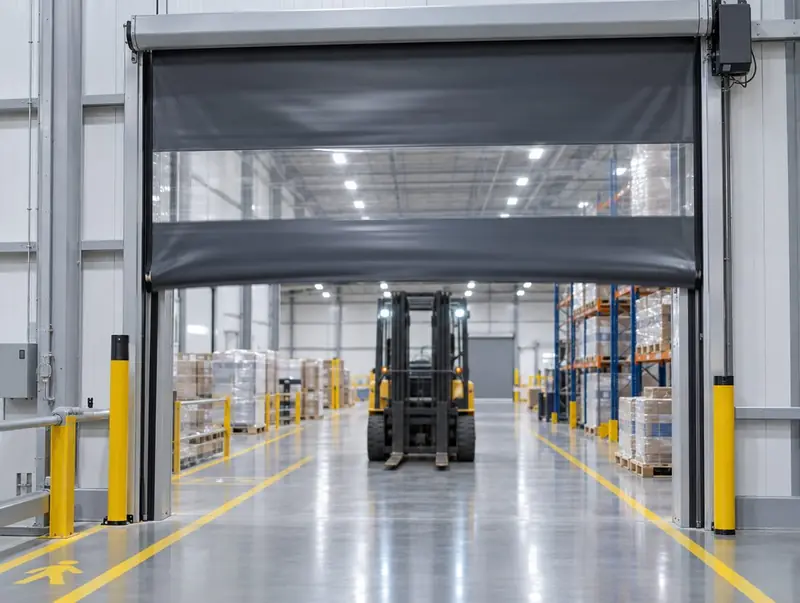
A high-speed door is a motorised door designed for hundreds or thousands of cycles a day, opening only when traffic arrives and closing again almost immediately. A frequency-inverter drive accelerates the curtain quickly and slows it at each end, so the door moves fast without slamming against its limits.
The point is to keep an opening closed as much as possible without slowing anyone down. On a busy forklift route, a conventional door is either left open all shift or becomes a bottleneck. A high-speed door cuts heat loss, draughts, dust, noise and pests, helps keep temperature-controlled areas stable and separates pedestrian and vehicle zones visually. Our high-speed doors guide covers the main types in more depth.
Fabric or spiral: which high-speed door do you need?
The choice comes down to where the door is, how exposed it is and whether it needs to insulate or secure the building.
- Fabric roll-up doors use a flexible PVC-coated curtain that winds onto a drum. They are lighter, lower cost and often self-repairing, which makes them ideal for internal openings between production, storage and dispatch, and for many sheltered external doors.
- Insulated fabric doors add a multi-layer curtain for chilled areas and external openings where heat loss matters.
- Spiral doors use rigid insulated aluminium slats that run in a spiral guide without touching each other, so they open very quickly with little wear. They work as the main external door of a building, resist wind well and give real security when closed.
Cold rooms and freezers use dedicated models with heated guides; see our cold store doors page for those.
What happens when a forklift hits the door?
On a well-specified fabric door, a forklift strike usually costs minutes rather than days, because the door is designed for it. Many fabric doors have a breakaway bottom bar that releases from the guides when struck and a self-repairing curtain that feeds itself back into the guides on the next cycle, often without an engineer visit. Some designs use a flexible bottom edge with no rigid bar at all, which reduces the risk of injury if a pedestrian is struck.
Spiral doors are rigid and cannot break away in the same way, so they rely on good activation and detection to stay out of the way, plus protection to the frame. In both cases a light curtain built into the side frames watches the full height of the opening and stops the door closing while anything is in it.
How should a high-speed door be activated?
A high-speed door should be activated by whatever matches the traffic using it, and that choice decides whether the door works well or becomes a nuisance. We set it up around the traffic you actually have:
- Radar above the door detects approaching vehicles or people, and can be set to ignore cross traffic.
- Induction loops cut into the floor detect only vehicles, so pedestrians do not trigger the door.
- Pull cords and push-buttons give deliberate control on routes shared with pedestrians.
- Interlocks link two doors in an airlock or with a dock door so only one opens at a time.
- Traffic lights show drivers when the door is fully open.
Hold-open time and opening height can be adjusted so a pallet truck does not open the full height of a tall door. If you are still choosing between a door and something simpler, compare strip curtains and high-speed doors.
How is a high-speed door installed and maintained?
A high-speed door arrives as a self-supporting frame with the drive and curtain already matched, so installation is mainly about a square, firm fixing to the structure, accurate levelling at the floor and careful commissioning of the controls and safety functions. A typical fabric door is fitted in a day; spiral doors and doors with interlocks or loops take longer. Most high-speed doors need a three-phase supply to a local isolator, which your electrician usually provides before we arrive.
Because these doors cycle so often, they wear faster than ordinary doors. Plan on servicing more often than once a year where cycle counts are high, and use the cycle counter in the control panel to set the interval. Fabric curtains, bottom bars and drive belts are wear items, and keeping spares on site for busy doors reduces downtime.
At a glance
- Curtain types
- PVC-coated polyester fabric, insulated fabric, or rigid aluminium slats on a spiral
- Opening speed
- Typically around 1–2 m/s for fabric doors; spiral doors can be faster, depending on model and size
- Drive
- Direct-drive motor with frequency inverter for soft start and stop
- Activation
- Radar, induction loop, pull cord, push-button, remote or interlock with other doors
- Safety
- Light curtain or photocells in the frame, plus safety edge where required
- Impact
- Breakaway bottom bar and self-repairing curtain on many fabric models
- Wind
- Wind bars or tensioned curtains for external use
- Vision
- Clear PVC vision strips or full-vision windows
Guide prices
| Item | Guide price (ex VAT) |
|---|---|
| High-speed fabric door | £7,495 – £15,995 |
| High-speed spiral (rigid slat) door | £17,995 – £34,995 |
Guide prices for supply and installation unless stated, excluding VAT, which is added at the current rate where it applies. Your fixed price is confirmed in writing after a survey, before any work starts.
What we check on the survey
- Opening size and the space above and beside it for the drum or spiral and side frames
- Daily cycle count and the mix of forklifts, pallet trucks and pedestrians
- Internal or external position, wind exposure and temperature difference
- Activation method and any interlock with other doors or dock equipment
- Floor condition and level at the threshold, and where loops can be cut
- Power supply (often three phase) and position of the control panel
High-speed doors: frequently asked questions
How fast does a high-speed door open?
Opening speeds vary by model and size, but fabric doors typically open at around 1–2 metres per second and spiral doors can be faster. Closing is usually slower than opening for safety. Speeds are set during commissioning within the manufacturer's limits and the safety requirements for the site.
Can a high-speed door be used as the main external door?
Yes, with the right model. Spiral doors and wind-resistant fabric doors are made for external openings. On exposed elevations we may suggest a high-speed door inside a conventional roller shutter or sectional door, with the outer door closed at night for security.
Are high-speed doors safe for pedestrians?
They are designed to be, with light curtains watching the opening, controlled closing forces and soft or breakaway bottom edges on many models. Even so, a separate pedestrian door is usually the safer option on busy routes, and the site's risk assessment should decide how people and vehicles are separated.
Do high-speed doors save energy?
They reduce the time an opening stands open, which cuts heat loss and draughts compared with a door left open for convenience. The actual saving depends on your building, the temperature difference and traffic levels, so we do not quote a fixed figure.
Areas we cover for high-speed doors
We cover England, Wales, Scotland and Northern Ireland; islands and remote sites by arrangement. Choose your area for local details and the law that applies there.
England
- Bedfordshire
- Berkshire
- Bristol
- Buckinghamshire
- Cambridgeshire
- Cheshire
- Cornwall
- County Durham
- Cumbria
- Derbyshire
- Devon
- Dorset
- East Riding of Yorkshire
- East Sussex
- Essex
- Gloucestershire
- Greater London
- Greater Manchester
- Hampshire
- Herefordshire
- Hertfordshire
- Isle of Wight
- Kent
- Lancashire
- Leicestershire
- Lincolnshire
- Merseyside
- Norfolk
- North Yorkshire
- Northamptonshire
- Northumberland
- Nottinghamshire
- Oxfordshire
- Rutland
- Shropshire
- Somerset
- South Yorkshire
- Staffordshire
- Suffolk
- Surrey
- Tyne and Wear
- Warwickshire
- West Midlands
- West Sussex
- West Yorkshire
- Wiltshire
- Worcestershire
Wales
Scotland
- Aberdeen and Aberdeenshire
- Angus and Dundee
- Argyll and Bute
- Ayrshire
- Dumfries and Galloway
- Edinburgh and the Lothians
- Fife
- Forth Valley
- Glasgow
- Highlands and Islands
- Lanarkshire
- Perth and Kinross
- Renfrewshire and Dunbartonshire
- Scottish Borders
Northern Ireland
Last updated 19 October 2026.