Quick answer
A door safety upgrade adds or replaces the devices that stop a powered industrial door from crushing, striking or falling on people: safety edges on the closing edge, photocells or light curtains across the opening, anti-fall and spring-break devices, and warning lights. The door is then force-tested and its risk assessment updated. Guide price £445 to £1,795 ex VAT per door for edges, photocells or a light curtain.
Why do powered doors need safety upgrades?
Many powered doors in use today were installed or converted before current expectations for safety were in place, or have had safety devices disabled, damaged or bypassed over the years. A door that can close under power onto a person or vehicle, or one that could fall if a spring or cable breaks, presents a serious risk.
Employers and occupiers in England, Wales and Scotland must keep work equipment and doors safe and in efficient working order under the Workplace (Health, Safety and Welfare) Regulations 1992 and PUWER 1998, and powered doors must have features to prevent people being trapped. Northern Ireland has equivalent duties under its own workplace and work equipment regulations, enforced by HSENI. An upgrade brings an older door into line with the protection a current risk assessment would expect. Our guide to industrial door safety law explains the duties in each nation.
Which safety devices does a powered door need?
The right package depends on how the door is controlled and who is near it. A door operated on hold-to-run, where the user must keep pressing the button and can see the whole door, may need little more than limited forces. Once the door closes on a single press, a timer, remote or automatic activation, protection is needed against it closing on someone:
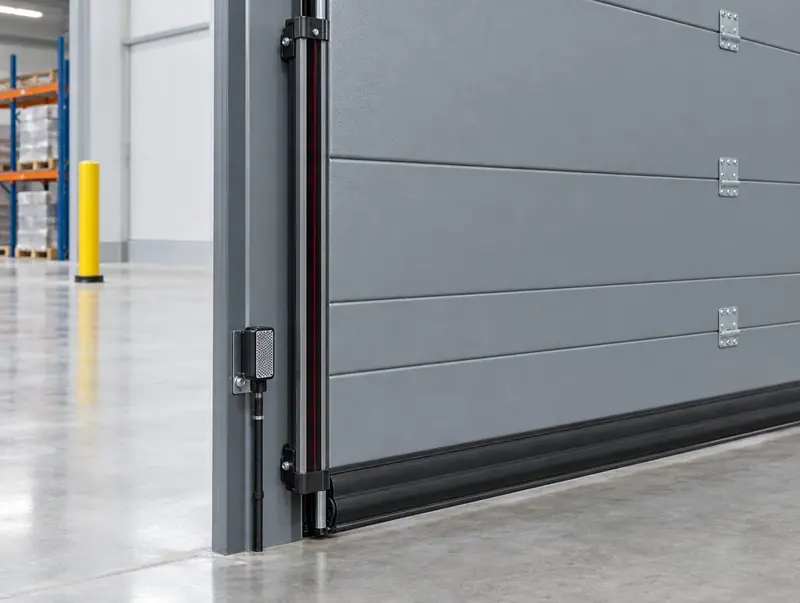
- Safety edges on the bottom rail stop and reverse the door on contact.
- Photocells across the opening stop the door closing while the beam is broken.
- Light curtains cover the full height of the opening with multiple beams, giving much fuller detection than a single photocell pair.
- Fall protection, such as spring-break or cable-break devices on sectional doors and anti-fall devices on roller shutters, stops the door falling if its suspension fails.
BS EN 12453 sets out how these safety functions should perform and how they are monitored.
What is force testing?
Force testing measures the force a closing door exerts when it meets an obstruction, using a calibrated force-measuring instrument placed at specified points in the opening. BS EN 12453 sets limits on those forces, including 400 N for crushing at defined positions and 1,400 N for the dynamic impact, along with how quickly the force must fall away.
A door that fails the test may need its control panel adjusted, its closing speed reduced, a safety edge fitted or replaced, or additional detection such as a light curtain so the door never reaches the obstruction. We record the results for each test point so you have evidence the door was checked. Force tests should be repeated after any change to the drive, controls or safety devices, and at intervals as part of planned maintenance.
Do older control panels need replacing?
Sometimes. Modern safety edges and light curtains are designed to be monitored, meaning the control panel checks the device is working before each closing movement and stops the door if a fault is detected. Older panels may not have monitored inputs, so a new edge or light curtain cannot be connected safely to them.
In that case, the upgrade includes a new control panel, which often brings other benefits: inverter control for smoother running, better fault diagnostics, and inputs for traffic lights, interlocks or additional activation. Where we replace a panel or add safety functions, we review the door's risk assessment and record the changes and test results.
How is an upgrade carried out and what does it cost?
The upgrade begins with a survey of the door, its controls, how it is used and who is around it, together with a force test of the door as it stands. From that we recommend the devices needed and quote a fixed price. Most upgrades are completed in a few hours per door, after which the door is re-tested and handed back with records.
Our guide price is £445 to £1,795 ex VAT per door for safety edges, photocells or a light curtain, depending on door size and the devices required. A new control panel or fall-protection device adds to the cost. Where a door has several safety failings and is in poor mechanical condition, replacement may be the better option, and our door replacement service can price that for comparison.
At a glance
- Safety edges
- Pressure-sensitive or optical edges on the bottom rail or closing leaf, with monitored connection
- Photocells
- Through-beam or reflective photocells across the opening
- Light curtains
- Multi-beam light curtains covering the full height of the opening
- Fall protection
- Spring-break, cable-break and anti-fall (safety catch) devices
- Force testing
- Closing forces measured against BS EN 12453 limits with a calibrated force tester
- Warnings
- Beacons, sounders and traffic lights
- Control
- Control panel upgrade where monitored safety inputs are needed
Guide prices
| Item | Guide price (ex VAT) |
|---|---|
| Safety upgrade (edges, photocells, light curtain) | £445 – £1,795 per door |
| Repair visit (attendance and first hour) | £145 – £195 |
Guide prices for supply and installation unless stated, excluding VAT, which is added at the current rate where it applies. Your fixed price is confirmed in writing after a survey, before any work starts.
What we check on the survey
- How the door is controlled: hold-to-run, impulse, timer or automatic
- Existing safety devices, their condition and whether they are monitored
- Closing forces measured at the test points
- Spring, cable and suspension condition and existing fall protection
- Pedestrian and vehicle routes near the door
- Control panel type and compatibility with new devices
Door safety upgrades: frequently asked questions
Is it a legal requirement to fit safety edges to a powered door?
The law requires powered doors to have features that prevent people being trapped and to be maintained safely; it does not name a specific device. Which devices are needed depends on the door's risk assessment and how it is controlled. For doors that close automatically or on a single press, safety edges and photocells or light curtains are the usual approach.
Our door has a safety edge. Is that enough?
It may be, but a safety edge only works on contact. Adding photocells or a light curtain stops the door before it touches someone, which is preferable on busy routes. A force test shows whether the edge and panel stop the door within the limits, and we recommend extra detection where the risk justifies it.
What is an anti-fall device?
An anti-fall device, or safety catch, stops a roller shutter falling if the drive, gearbox or barrel connection fails. On sectional doors, spring-break and cable-break devices do the same job if a spring or cable snaps. They are important on heavy doors where a falling curtain could cause serious injury.
How often should safety devices be checked?
Safety devices should be checked at every service, at least annually and more often on busy doors. Users should also report any damaged edges, misaligned photocells or doors that do not reverse. Never bypass a faulty safety device to keep a door running.
Areas we cover for door safety upgrades
We cover England, Wales, Scotland and Northern Ireland; islands and remote sites by arrangement. Choose your area for local details and the law that applies there.
England
- Bedfordshire
- Berkshire
- Bristol
- Buckinghamshire
- Cambridgeshire
- Cheshire
- Cornwall
- County Durham
- Cumbria
- Derbyshire
- Devon
- Dorset
- East Riding of Yorkshire
- East Sussex
- Essex
- Gloucestershire
- Greater London
- Greater Manchester
- Hampshire
- Herefordshire
- Hertfordshire
- Isle of Wight
- Kent
- Lancashire
- Leicestershire
- Lincolnshire
- Merseyside
- Norfolk
- North Yorkshire
- Northamptonshire
- Northumberland
- Nottinghamshire
- Oxfordshire
- Rutland
- Shropshire
- Somerset
- South Yorkshire
- Staffordshire
- Suffolk
- Surrey
- Tyne and Wear
- Warwickshire
- West Midlands
- West Sussex
- West Yorkshire
- Wiltshire
- Worcestershire
Wales
Scotland
- Aberdeen and Aberdeenshire
- Angus and Dundee
- Argyll and Bute
- Ayrshire
- Dumfries and Galloway
- Edinburgh and the Lothians
- Fife
- Forth Valley
- Glasgow
- Highlands and Islands
- Lanarkshire
- Perth and Kinross
- Renfrewshire and Dunbartonshire
- Scottish Borders
Northern Ireland
Last updated 19 October 2026.