Quick answer
A steel personnel door is a pedestrian doorset made of a galvanised steel leaf and frame, used for staff entrances, plant rooms and fire exits on industrial and commercial buildings. Fire exit versions carry panic hardware to BS EN 1125 or emergency exit devices to BS EN 179, chosen by who uses the exit. Guide prices £845 to £1,795 ex VAT for a single steel door, and £1,095 to £2,395 with panic hardware.
What is a steel personnel door used for?
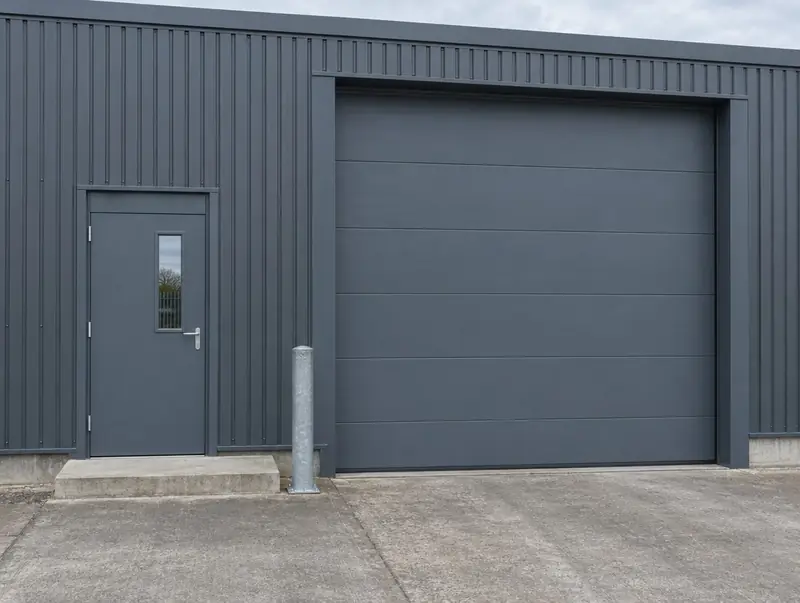
A steel personnel door is a pedestrian door built for heavy use and security in industrial and commercial buildings. The leaf is two galvanised steel skins bonded to a core, hung in a pressed steel frame on heavy-duty hinges, and finished in a polyester powder coat that resists knocks and weather far better than timber.
Typical uses include staff entrances beside loading doors, fire exits from warehouses and production areas, plant and switch rooms, external stores and the back doors of retail and trade units. Where a large door is fitted, a separate steel personnel door alongside is usually safer and more convenient than a wicket door built into the main door, and it keeps staff out of vehicle routes.
Panic bar or emergency exit device: which does your fire exit need?
Fire exit hardware lets people open a locked escape door from the inside in one simple action, without a key. Two standards cover the hardware, and the choice depends on who is likely to use the exit:
- Panic exit devices to BS EN 1125 use a horizontal bar across the leaf that opens the door when pushed anywhere along its length. They are for exits where people may not know the door or its hardware and where panic can be foreseen, such as areas open to the public, shops and places of assembly.
- Emergency exit devices to BS EN 179 use a lever handle or push pad. They are for exits used only by people who are familiar with the door and its hardware, such as trained staff in a warehouse or factory, where panic is not expected.
Guidance from the door industry is that if there is any doubt about who will use the exit, panic hardware to BS EN 1125 should be specified. The final decision should follow your fire risk assessment and the building regulations guidance that applies in your nation.
Do steel doors need to be fire rated?
Only where the door sits in a fire-resisting wall or protects an escape route, because not every steel door is a fire door. A fire exit door is about escape: it must be easy to open in the direction of travel. A fire-resisting door is about separation: it must hold back fire and smoke for a stated time. Some doors need to do both, for example an exit from a protected stair or a door in a compartment wall.
Where a fire-resisting door is needed, we supply steel doorsets carrying the manufacturer's test evidence for the rating, typically 30 or 60 minutes, and install them exactly to the manufacturer's instructions, including the frame fixings, the gap tolerances, the intumescent seals and any fire-rated glazing. Hardware fitted to a fire door must also be covered by that evidence. For larger fire-separated openings, see fire shutters.
How secure is a steel door?
A steel doorset is far harder to attack than timber or uPVC. Hinge bolts or dog bolts on the hinge side stop the leaf being lifted out if the hinges are cut, multi-point locks spread the load across the frame and a steel frame resists levering at the lock. Fire exit hardware can be paired with outside access devices, so staff can enter with a key or code while the exit stays free from inside.
Where an insurer or specifier requires a formal rating, we supply doorsets certified to LPS 1175, where the rating belongs to the manufacturer's tested product and depends on correct installation. Our guide to industrial door security ratings explains how ratings are expressed and checked.
How is a steel doorset installed and what does it cost?
Steel personnel doors are supplied as complete doorsets: frame, leaf, hinges and usually the lock and hardware, made to the structural opening size. Installation involves removing the old door and frame, preparing the opening, fixing the new frame plumb and square, hanging and adjusting the leaf, fitting closers and hardware, then sealing and making good. Most single doors are fitted in a day.
Our guide price for a single steel personnel door is £845 to £1,795 ex VAT, and £1,095 to £2,395 for a steel fire exit door with panic hardware, supplied and fitted. Fire rating, security rating, double or leaf-and-a-half configurations, louvres, vision panels and access control all add to the cost, along with strip-out and making good the opening.
At a glance
- Leaf
- Double-skin galvanised steel, typically around 45–60 mm thick, with honeycomb, foam or mineral fibre core
- Frame
- Pressed steel frame fixed into the opening, with integral rebates and seals
- Configurations
- Single, leaf-and-a-half or double doors, opening in or out
- Exit hardware
- Panic bars or touch bars to BS EN 1125; lever or push-pad emergency devices to BS EN 179
- Fire rating
- Fire-resisting doorsets with the manufacturer's test evidence, typically 30 or 60 minutes
- Security
- Hinge bolts, multi-point locking; LPS 1175 rated doorsets available
- Options
- Vision panels, louvres for plant rooms, overhead closers, kick plates and outside access devices
- Finish
- Polyester powder coat in RAL colours
Guide prices
| Item | Guide price (ex VAT) |
|---|---|
| Steel personnel door, single | £845 – £1,795 |
| Steel fire exit door with panic hardware | £1,095 – £2,395 |
| Strip-out and disposal on replacement | £345 – £1,195 per door |
Guide prices for supply and installation unless stated, excluding VAT, which is added at the current rate where it applies. Your fixed price is confirmed in writing after a survey, before any work starts.
What we check on the survey
- Structural opening size and the condition of the wall around it
- Direction of opening and whether the door is on an escape route
- Who uses the exit, to choose BS EN 1125 or BS EN 179 hardware
- Fire rating needed, if the door is in a fire-resisting wall
- Security requirements and any insurer specification
- Thresholds, closers, louvres, vision panels and outside access needs
Steel personnel and fire exit doors: frequently asked questions
Does a fire exit door have to open outwards?
Doors on escape routes should open in the direction of escape wherever reasonably practicable, and outward opening is normally expected where more than a small number of people use the exit. The building regulations guidance in each nation and your fire risk assessment set the exact requirement for your building.
Can a fire exit door be locked from outside?
Yes. A fire exit door can be secure from the outside, with an outside access device or no external hardware at all, provided it can always be opened from inside by the exit hardware without a key. Padlocks, chains or bolts that stop it opening from inside must never be used while the building is occupied.
Can you replace the panic bar on an existing door?
Yes. We replace worn or damaged panic bars and emergency exit devices, provided the door and frame are in reasonable condition. On a fire-resisting door, the replacement hardware must be covered by the door's fire test evidence, so we check that before fitting.
Are steel doors available in colours?
Yes. Steel doorsets are powder-coated, usually in a choice of standard RAL colours, so they can match cladding, windows or other doors on the building. Frames can be finished in the same colour or a contrasting one.
Areas we cover for steel personnel and fire exit doors
We cover England, Wales, Scotland and Northern Ireland; islands and remote sites by arrangement. Choose your area for local details and the law that applies there.
England
- Bedfordshire
- Berkshire
- Bristol
- Buckinghamshire
- Cambridgeshire
- Cheshire
- Cornwall
- County Durham
- Cumbria
- Derbyshire
- Devon
- Dorset
- East Riding of Yorkshire
- East Sussex
- Essex
- Gloucestershire
- Greater London
- Greater Manchester
- Hampshire
- Herefordshire
- Hertfordshire
- Isle of Wight
- Kent
- Lancashire
- Leicestershire
- Lincolnshire
- Merseyside
- Norfolk
- North Yorkshire
- Northamptonshire
- Northumberland
- Nottinghamshire
- Oxfordshire
- Rutland
- Shropshire
- Somerset
- South Yorkshire
- Staffordshire
- Suffolk
- Surrey
- Tyne and Wear
- Warwickshire
- West Midlands
- West Sussex
- West Yorkshire
- Wiltshire
- Worcestershire
Wales
Scotland
- Aberdeen and Aberdeenshire
- Angus and Dundee
- Argyll and Bute
- Ayrshire
- Dumfries and Galloway
- Edinburgh and the Lothians
- Fife
- Forth Valley
- Glasgow
- Highlands and Islands
- Lanarkshire
- Perth and Kinross
- Renfrewshire and Dunbartonshire
- Scottish Borders
Northern Ireland
Last updated 19 October 2026.