
Quick answer
A PVC strip curtain is a row of overlapping flexible PVC strips hung from a rail across a doorway. People, trolleys and forklifts pass straight through, and the strips fall back into place behind them, cutting draughts, dust, noise, insects and the loss of heated or chilled air. It is the simplest, lowest-cost way to part-close a busy opening. Guide price £175 to £895 ex VAT per doorway, supplied and fitted.
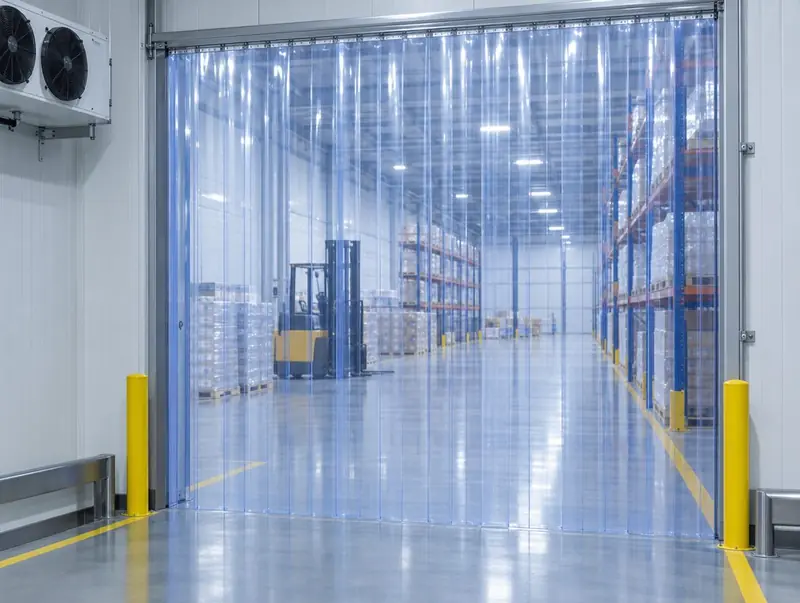
What does a strip curtain do?
A strip curtain closes an opening that cannot practically be closed by a door because traffic passes too often. The strips hang edge to edge with an overlap, so they form a near-continuous barrier when still but part easily around whatever pushes through them and then drop back into place.
That makes a big difference to an opening left standing open. A strip curtain reduces draughts and the loss of heated or chilled air, keeps out much of the dust, fumes, birds and insects, and dampens noise between areas. It needs no power, has no moving mechanism and can be fitted inside an existing door, so the door can stay open through the shift and close at night. That combination is common on loading bays, where the main door is opened at the start of the day and the strips do the work between deliveries.
Which strip grade and size do you need?
The grade of PVC and the size of strip follow the environment and the traffic.
- Standard clear strips suit most ambient warehouse and workshop doorways.
- Polar grade strips stay flexible at low temperatures for chillers, cold stores and freezers, where standard PVC would stiffen and crack.
- Ribbed strips have raised ribs that take the abrasion from forklifts and pallets, keeping the clear area between them scratch-free for longer.
- Anti-insect strips are tinted to deter flying insects in food areas.
- Weld-screen strips are tinted to protect people nearby from welding arc light.
Wider and thicker strips suit tall openings and forklift traffic; narrower, thinner strips are easier for pedestrians to push through. Greater overlap seals better but makes the curtain heavier to pass. On external openings exposed to wind, extra overlap and heavier strips stop the curtain blowing open, while internal doorways between similar temperatures can use a lighter specification.
Strip curtain, traffic door or high-speed door?
Strip curtains are the lowest-cost option and work for most openings, but they are not right everywhere. Strips can obscure the view as they become scratched, and drivers and pedestrians may not see each other through a dirty or worn curtain. Strips also need to be kept clean in food areas and replaced as they wear.
Where hygiene, appearance or a better seal matters on pedestrian and trolley routes, impact traffic doors are often a better fit. Where forklifts pass hundreds of times a shift or temperature control is critical, a high-speed door seals far better and gives a clear view. Our guide comparing strip curtains and high-speed doors sets out where each makes sense.
How are strip curtains installed?
A steel or stainless rail is fixed above the opening, either across the face of the wall or inside the reveal, and the strips are hung from it on hook-on plates or clamped mounting plates. Hook-on systems let individual strips be lifted off and replaced in seconds, which helps where one or two strips at forklift height wear faster than the rest.
Fitting typically takes an hour or two per doorway once the strips are cut to length, so there is little disruption. On wide or tall openings we may add a sliding or swing-away rail so the curtain can be pushed clear for oversized loads. In cold stores we cut strips to sit just above the floor so they do not freeze to it.
How much does a strip curtain cost and how long does it last?
Our guide price is £175 to £895 ex VAT per doorway, supplied and fitted. Opening size, strip grade, width, thickness, overlap and the type of rail set the figure; polar, ribbed and specialist grades cost more than standard clear PVC.
Strip life depends almost entirely on traffic. In a pedestrian doorway, strips can last for years; on a busy forklift route they may need replacing much sooner as they scratch, tear or lose transparency. Replacing worn strips promptly keeps visibility good, which matters for safety where vehicles and people share the route. Replacement strips can be supplied cut to length for your existing rail. In food areas, strips should be cleaned on the same schedule as surrounding surfaces, and hook-on plates make it easy to take them down for washing.
At a glance
- Strip grades
- Standard clear, polar (low-temperature), ribbed, anti-insect, anti-static and weld-screen
- Strip sizes
- Typically 200–400 mm wide and 2–4 mm thick, chosen by opening size and traffic
- Overlap
- Strips overlap their neighbours, with more overlap on exposed or cold openings
- Mounting
- Face-fixed or reveal-fixed rail, hook-on plates for easy strip replacement
- Options
- Sliding or swing-away rails so the curtain can be moved clear when not needed
- Temperature
- Polar-grade strips stay flexible at freezer temperatures
- Visibility
- Clear strips keep a view through the doorway in both directions
Guide prices
| Item | Guide price (ex VAT) |
|---|---|
| PVC strip curtain, per doorway | £175 – £895 |
| Impact traffic doors, pair | £895 – £2,495 |
Guide prices for supply and installation unless stated, excluding VAT, which is added at the current rate where it applies. Your fixed price is confirmed in writing after a survey, before any work starts.
What we check on the survey
- Opening width and height, and the mounting surface above it
- Traffic: pedestrians, trolleys, pallet trucks or forklifts
- Temperature on each side, to choose standard or polar grade
- Specific needs: insect control, welding screens, anti-static areas
- Visibility requirements where vehicles and pedestrians meet
- Whether the curtain needs to slide or swing clear for large loads
PVC strip curtains: frequently asked questions
Do strip curtains really save energy?
They reduce the amount of heated or chilled air lost through an opening that would otherwise stand open, which helps temperature control. How much energy is saved depends on the opening, the temperature difference and the traffic, so we do not quote a fixed figure. They are less effective than a door that is actually closed.
Can I replace just the worn strips?
Yes. With hook-on mounting systems, individual strips lift off the rail and new strips cut to the right length hook straight on. We can supply replacement strips to match your existing rail and opening height.
Are strip curtains suitable for freezers?
Yes, using polar-grade PVC that stays flexible at low temperatures. Standard PVC becomes stiff and brittle in the cold. Strips are cut to sit just clear of the floor so they do not freeze to it.
Are strip curtains safe for forklift routes?
They are widely used on forklift routes, but visibility must be kept good. Clear or ribbed strips should be replaced when they become scratched or cloudy, and the site risk assessment should consider how drivers and pedestrians see each other at the opening.
Areas we cover for PVC strip curtains
We cover England, Wales, Scotland and Northern Ireland; islands and remote sites by arrangement. Choose your area for local details and the law that applies there.
England
- Bedfordshire
- Berkshire
- Bristol
- Buckinghamshire
- Cambridgeshire
- Cheshire
- Cornwall
- County Durham
- Cumbria
- Derbyshire
- Devon
- Dorset
- East Riding of Yorkshire
- East Sussex
- Essex
- Gloucestershire
- Greater London
- Greater Manchester
- Hampshire
- Herefordshire
- Hertfordshire
- Isle of Wight
- Kent
- Lancashire
- Leicestershire
- Lincolnshire
- Merseyside
- Norfolk
- North Yorkshire
- Northamptonshire
- Northumberland
- Nottinghamshire
- Oxfordshire
- Rutland
- Shropshire
- Somerset
- South Yorkshire
- Staffordshire
- Suffolk
- Surrey
- Tyne and Wear
- Warwickshire
- West Midlands
- West Sussex
- West Yorkshire
- Wiltshire
- Worcestershire
Wales
Scotland
- Aberdeen and Aberdeenshire
- Angus and Dundee
- Argyll and Bute
- Ayrshire
- Dumfries and Galloway
- Edinburgh and the Lothians
- Fife
- Forth Valley
- Glasgow
- Highlands and Islands
- Lanarkshire
- Perth and Kinross
- Renfrewshire and Dunbartonshire
- Scottish Borders
Northern Ireland
Last updated 19 October 2026.