
Quick answer
Industrial door replacement is the removal of an old, damaged or unsuitable door and the installation of a new one in the same opening, including strip-out, disposal, any repairs or framing the opening needs, and commissioning the new door with its safety devices and paperwork. Replacements get a free survey. Guide price £345 to £1,195 ex VAT per door for strip-out and disposal, plus the new door.
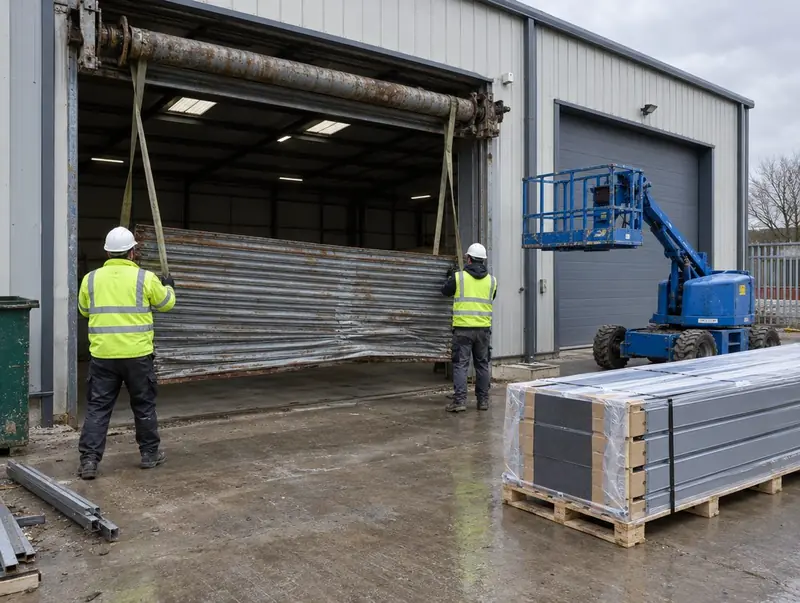
When should an industrial door be replaced?
An industrial door should be replaced when repairing it no longer makes sense: when it is badly damaged across the curtain or panels, when the same faults keep recurring, when parts are no longer made, when corrosion has weakened guides or bottom rails, or when the door simply does not suit how the opening is used any more. A door that is safe but uninsulated, slow or insecure can also be worth replacing if it is costing you in heat loss, time or insurance.
We are honest about this. If a door can be repaired economically, we will say so, and our industrial door repairs service will handle it. Where replacement makes more sense, we explain why and price it alongside the repair so you can compare cost and remaining life, taking into account running costs, downtime and how much longer you expect to occupy the building.
Like-for-like or a different door?
Either, depending on how the opening is used now: replacement is a chance to reconsider what it needs. Many sites change door type when they replace:
- Single-skin roller shutter to insulated roller or sectional door where the building is now heated or the door is draughty.
- Manual to electric where the door is now opened many times a shift.
- Conventional to high-speed on busy internal routes or openings that are left standing open.
- Standard to security-rated where an insurer now asks for a rated product.
The survey checks headroom, side room and back room, because a different door type may need more space than the old one. Insulated roller curtains coil larger than single-skin ones, and sectional doors need track space under the roof. If you are deciding between the two most common types, see sectional or roller shutter doors.
What does strip-out involve?
Strip-out involves releasing spring tension safely, dismantling and removing the old door and its drive, then inspecting the opening, so it is more than unbolting the old door. Sectional doors and many roller shutters are counterbalanced by springs under high tension, and those springs must be safely unwound before the door is dismantled. The curtain or panels are taken down in sections, the guides, tracks, barrel and drive removed, and the controls and wiring made safe for the new installation.
Once the old door is out, the engineer inspects the opening. Old fixings often leave damaged blockwork or concrete, timber framing may have rotted, and steel jambs may be corroded at the base. Any repairs needed so the new door can be fixed securely are included in the quote. Our guide price for strip-out and disposal is £345 to £1,195 ex VAT per door, depending on size, type and access, and the old door is taken away for recycling or disposal.
How is the changeover planned?
The new door is made to measure, so it is ordered after the survey and the changeover is booked for when it arrives. That way the opening is only out of use for the time it takes to strip out and fit, typically a day for a single door. Where several doors are being replaced, we work through them one at a time so the site keeps operating.
Where security matters, the old door stays in place until the new one is on site, and the work is planned so the opening is closed again by the end of the day. Early starts, evenings and weekends can be arranged for sites that cannot spare an opening during working hours, with any extra cost shown in the quote.
What do you get at handover?
When the new door is fitted, it is commissioned: limits set, safety devices fitted and tested, closing forces measured where the door closes under power, and the manual override checked. You receive the manufacturer's Declaration of Performance, the user instructions, and for powered doors the Declaration of Conformity and commissioning records. Where we have assembled or motorised the door on site, we take on the manufacturer's responsibilities for it under machinery law.
From then on, the door needs regular servicing to stay safe and reliable. We can add it to a planned maintenance schedule from the first year, so its service history starts on day one.
At a glance
- Survey
- Free survey of the opening, structure, services and how the door is used
- Strip-out
- Safe removal of the old curtain, panels, springs, guides, drive and controls
- Disposal
- Old door taken away for recycling or disposal
- Opening works
- Repairs to jambs and head, new steel or timber framing, making good
- New door
- Like-for-like or a different door type better suited to the opening
- Commissioning
- Safety devices fitted and tested, forces measured, user instructions handed over
- Paperwork
- Declaration of Performance and, for powered doors, Declaration of Conformity
Guide prices
| Item | Guide price (ex VAT) |
|---|---|
| Strip-out and disposal on replacement | £345 – £1,195 per door |
| Industrial roller shutter, single-skin steel, electric (to c. 4 × 4 m) | £2,395 – £5,495 |
| Sectional overhead door, 40 mm insulated, electric (to c. 4 × 4.5 m) | £3,495 – £8,495 |
Guide prices for supply and installation unless stated, excluding VAT, which is added at the current rate where it applies. Your fixed price is confirmed in writing after a survey, before any work starts.
What we check on the survey
- Condition of the existing door and why it is being replaced
- Opening size, squareness and the condition of jambs, head and floor
- Headroom, side room and back room for the new door type
- Power supply, controls and safety devices wanted
- Security and insulation requirements for the new door
- Access for strip-out and disposal, and timing constraints
Industrial door replacement: frequently asked questions
Is the survey for a replacement door free?
Yes. Surveys for new installations and replacements are free. We inspect the existing door and opening, measure for the new door, check space, fixings and power, and give you a written fixed price before any work starts.
Can the old motor or guides be reused?
Usually not. Old guides, barrels and motors are matched to the old door, and reusing them with a new curtain or panels rarely works well and can compromise the new door's safety and conformity. We recommend a complete new door, which is also what the manufacturer's documentation covers.
What happens to the old door?
We remove it and take it away for recycling or disposal as part of the strip-out. The cost is shown as a separate line in the quote, so you can see exactly what is being charged for removal.
Will the opening need building work?
Sometimes. Old fixings, corrosion or rotten timber framing can mean the jambs or head need repair or new framing before the new door is fitted. We check this on survey and include it in the quote, or confirm it on the day once the old door is out.
Areas we cover for industrial door replacement
We cover England, Wales, Scotland and Northern Ireland; islands and remote sites by arrangement. Choose your area for local details and the law that applies there.
England
- Bedfordshire
- Berkshire
- Bristol
- Buckinghamshire
- Cambridgeshire
- Cheshire
- Cornwall
- County Durham
- Cumbria
- Derbyshire
- Devon
- Dorset
- East Riding of Yorkshire
- East Sussex
- Essex
- Gloucestershire
- Greater London
- Greater Manchester
- Hampshire
- Herefordshire
- Hertfordshire
- Isle of Wight
- Kent
- Lancashire
- Leicestershire
- Lincolnshire
- Merseyside
- Norfolk
- North Yorkshire
- Northamptonshire
- Northumberland
- Nottinghamshire
- Oxfordshire
- Rutland
- Shropshire
- Somerset
- South Yorkshire
- Staffordshire
- Suffolk
- Surrey
- Tyne and Wear
- Warwickshire
- West Midlands
- West Sussex
- West Yorkshire
- Wiltshire
- Worcestershire
Wales
Scotland
- Aberdeen and Aberdeenshire
- Angus and Dundee
- Argyll and Bute
- Ayrshire
- Dumfries and Galloway
- Edinburgh and the Lothians
- Fife
- Forth Valley
- Glasgow
- Highlands and Islands
- Lanarkshire
- Perth and Kinross
- Renfrewshire and Dunbartonshire
- Scottish Borders
Northern Ireland
Last updated 19 October 2026.