Quick answer
A complete loading bay is the full set of equipment at one dock position, designed to work together: typically an insulated sectional door, a hydraulic dock leveller, a dock shelter, bumpers, wheel guides, traffic lights and interlocks between them. Installing it as one package avoids gaps between suppliers and makes the bay safer to use. Priced on survey; typically £14,995 to £39,995 ex VAT per bay.
What is included in a complete loading bay?
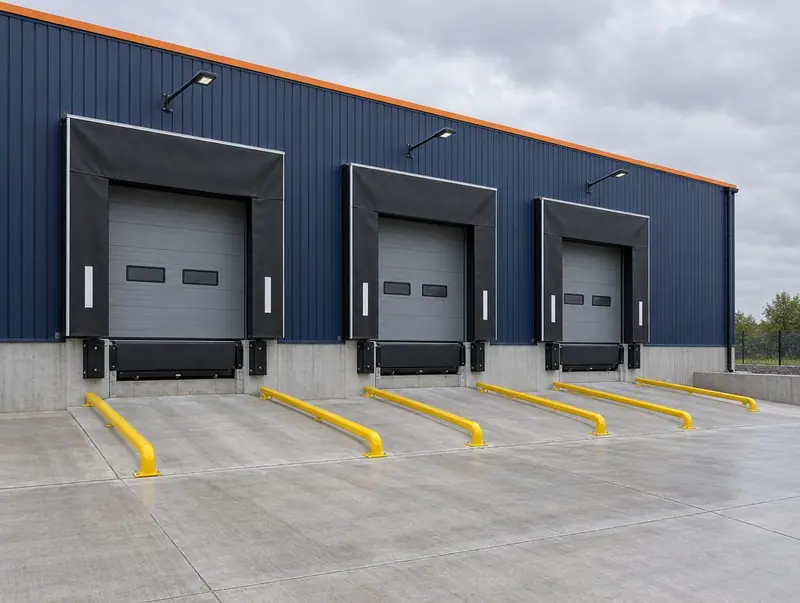
A complete loading bay includes everything needed to move goods safely between a vehicle and the building at one dock position. The core items are the dock door, the dock leveller and the dock shelter or seal, with bumpers to stop trailers at the right distance, wheel guides to centre them, traffic lights to tell drivers when it is safe to pull away and dock lights for working inside the trailer.
Bought separately, each item can work well on its own and still leave a bay that does not work as a whole: a shelter that does not seal because the bumpers are too thin, a leveller that will not deploy because the door limits are set too low, or a door that can be closed onto a deployed leveller. Planning them together means one survey, one set of dimensions and one team responsible for the way the bay behaves.
How should the bay be laid out?
The bay should be laid out around the dock type, the apron and the way vehicles move in the yard, and those decisions need making before anything is ordered. Most UK distribution buildings use flush docks, where the leveller sits inside the building line and the shelter seals the trailer against the wall. Where the building cannot be altered, a loading house, a steel enclosure built out from the wall, can contain the leveller in front of the door and leave the warehouse floor clear.
The apron, the area of yard in front of the bays, needs enough depth for vehicles to manoeuvre, and any slope down to the dock should be gentle enough to keep trailers level with the dock and drain water away from the door. Bay spacing affects whether drivers can reverse in without clipping neighbouring shelters. Our guide to loading bay design covers apron depth, gradients and spacing in more detail.
Which safety systems should a loading bay have?
The biggest loading bay risks are vehicles pulling away while a forklift is still in the trailer, falls from the dock edge and people being struck in the yard. A well-specified bay addresses each one:
- Traffic lights inside and outside the door show drivers and forklift operators when the bay is safe to use.
- Interlocks let the leveller operate only with the door fully open and stop the door closing onto a deployed leveller.
- Vehicle restraints or wheel chocks with sensors hold the trailer in place until loading is complete.
- Dock edge protection and lighting reduce the risk of falls and help people see inside the trailer.
Which measures you need should follow your own risk assessment and your yard management procedures, including how keys or trailer brakes are controlled. Our guide to industrial door safety law covers the duties for the powered equipment in the bay.
How is a loading bay project delivered?
On a new building, the bay is designed with the architect and groundworks contractor from the outset: pit dimensions, door opening sizes, embedded steel for bumpers and cable routes to the control panel are fixed before the slab is poured. We supply those details early and install the equipment once the building is weathertight, usually as a sequence of door, leveller, shelter and accessories, then commission the interlocks and lights together.
On an existing building, bays can be refurbished one at a time so the site can keep trading. Old doors, levellers and shelters are removed, pits repaired or re-edged and the new equipment fitted and commissioned before moving to the next bay. A single bay with a prepared pit typically takes two to three days, depending on what is being replaced.
What does a complete loading bay cost?
Complete loading bays are priced on survey, typically £14,995 to £39,995 ex VAT per bay. The spread reflects the choices involved: a swing-lip leveller, retractable shelter and standard sectional door sit at the lower end, while telescopic levellers, inflatable shelters, vehicle restraints, loading houses and full interlock packages push the figure up. Pit construction or repair, steelwork and electrical supplies are priced separately where needed.
Multiple bays on the same site usually cost less per bay than a single one. For individual components, see the guide prices on our dock levellers page and the other component pages, which also explain what each item does at the bay.
At a glance
- Door
- Insulated sectional overhead door, usually with vision panels and electric operation
- Leveller
- Hydraulic swing-lip or telescopic-lip leveller sized to your fleet
- Seal
- Retractable or inflatable dock shelter, or foam seals for uniform fleets
- Impact
- Dock bumpers, wheel guides and bollards to protect the building and equipment
- Signals
- Inside and outside traffic lights, dock lights for working inside trailers
- Interlocks
- Door, leveller and vehicle restraint linked so they operate in safe sequence
- Layouts
- Flush docks, enclosed docks, drive-through or saw-tooth configurations
- Options
- Vehicle restraints, loading houses (pre-docking enclosures), canopy or rain gutters
Guide prices
| Item | Guide price (ex VAT) |
|---|---|
| Complete loading bay | on survey (typically £14,995 – £39,995 per bay) |
| Dock leveller, hydraulic swing-lip, into prepared pit | £6,495 – £10,995 |
| Dock shelter (retractable) | £2,195 – £5,495 |
Guide prices for supply and installation unless stated, excluding VAT, which is added at the current rate where it applies. Your fixed price is confirmed in writing after a survey, before any work starts.
What we check on the survey
- Dock height, apron depth and gradient, and drainage in front of each bay
- Vehicle types, bed heights and widths that use the bays
- Existing pits, door openings, bumpers and the condition of the dock edge
- Forklifts, pallet trucks and load weights crossing the leveller
- Temperature and security needs inside the building
- Power supplies, control panel positions and preferred interlocks
Complete loading bays: frequently asked questions
Can loading bays be refurbished while the site keeps operating?
Yes. Work can be phased one bay at a time, so the others stay in use. Each bay is stripped, any pit repairs carried out, and the new door, leveller and shelter fitted and commissioned before we move on. Weekend and out-of-hours working can be arranged where needed.
Do you build the dock pit as well?
On new builds we supply the pit details to your groundworks contractor, who forms the pit in the slab. On existing sites we can repair, re-edge or modify pits as part of the job, or arrange the concrete work as part of our quote where a new pit is needed.
What is a loading house?
A loading house is an insulated steel enclosure built out from the building in front of the dock door, containing the leveller and carrying the shelter. It allows a loading bay to be added without cutting a pit in the existing floor and keeps the warehouse floor fully usable inside the door.
Are traffic lights and interlocks worth adding to existing bays?
On busy bays, often yes. They make it clear when a trailer can be worked or driven away and stop equipment being used out of sequence. Most can be retrofitted to existing doors and levellers, subject to the controls fitted, and we check compatibility on survey.
Areas we cover for complete loading bays
We cover England, Wales, Scotland and Northern Ireland; islands and remote sites by arrangement. Choose your area for local details and the law that applies there.
England
- Bedfordshire
- Berkshire
- Bristol
- Buckinghamshire
- Cambridgeshire
- Cheshire
- Cornwall
- County Durham
- Cumbria
- Derbyshire
- Devon
- Dorset
- East Riding of Yorkshire
- East Sussex
- Essex
- Gloucestershire
- Greater London
- Greater Manchester
- Hampshire
- Herefordshire
- Hertfordshire
- Isle of Wight
- Kent
- Lancashire
- Leicestershire
- Lincolnshire
- Merseyside
- Norfolk
- North Yorkshire
- Northamptonshire
- Northumberland
- Nottinghamshire
- Oxfordshire
- Rutland
- Shropshire
- Somerset
- South Yorkshire
- Staffordshire
- Suffolk
- Surrey
- Tyne and Wear
- Warwickshire
- West Midlands
- West Sussex
- West Yorkshire
- Wiltshire
- Worcestershire
Wales
Scotland
- Aberdeen and Aberdeenshire
- Angus and Dundee
- Argyll and Bute
- Ayrshire
- Dumfries and Galloway
- Edinburgh and the Lothians
- Fife
- Forth Valley
- Glasgow
- Highlands and Islands
- Lanarkshire
- Perth and Kinross
- Renfrewshire and Dunbartonshire
- Scottish Borders
Northern Ireland
Last updated 19 October 2026.