Quick answer
A fire shutter is a steel roller shutter tested to hold back fire for a set period, typically 60 to 240 minutes, that closes automatically when the fire alarm or a fusible link releases it. It protects openings in compartment walls, conveyor routes and serveries. Its rating comes from the manufacturer's test evidence. Guide price £4,495 to £11,995 ex VAT for a single shutter with control panel and fail-safe closing.
What is a fire shutter?
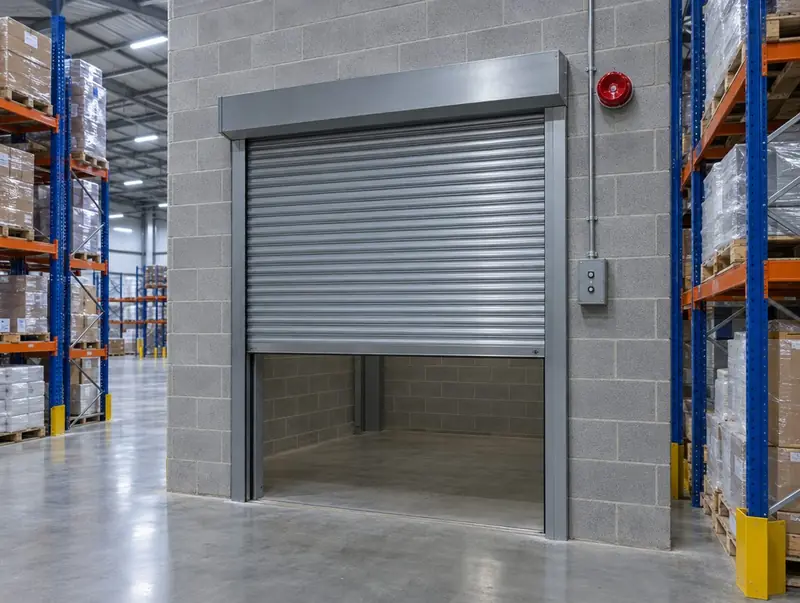
A fire shutter is a roller shutter designed and tested to stop fire passing through an opening in a fire-resisting wall for a stated period. It looks much like an ordinary shutter, but the curtain, guides, barrel, end plates and fixings have all been tested together as a system in a furnace, and the shutter carries the rating that system achieved.
Most of the time a fire shutter stays open. When the fire alarm signals, or mains power fails, the shutter descends under its own weight at a controlled speed and closes the opening, reinstating the fire compartment. Typical locations include openings between warehouse compartments, conveyor routes between floors or buildings, kitchen serveries and openings onto escape routes or protected corridors.
Where does the fire rating come from?
The fire rating belongs to the manufacturer's tested product, not to the installer. A new CE or UKCA-marked fire shutter is tested to BS EN 1634-1 and classified to BS EN 13501-2 under the product standard BS EN 16034, used with BS EN 13241, and is supplied with a Declaration of Performance. Older shutters already installed may instead hold test evidence to BS 476-22. Either way, the evidence covers a particular construction, size range and type of supporting wall.
A shutter only performs as tested if it is installed exactly as the manufacturer's certified specification describes: the right fixings at the right centres, into a wall of the right construction, with the gaps fire-stopped as stated. We supply shutters carrying that evidence and install them to the specification. If your fire strategy calls for something other than a shutter, our guide to fire shutters and fire curtains explains the alternatives.
How does the shutter link to the fire alarm?
Almost every fire shutter is released by a signal from the fire detection and alarm system. The interface between alarm and shutter is commonly designed using BS 7273-4, the code of practice for door release mechanisms, which grades how critical the release is and how the signal path must be monitored or made fail-safe. In practice the shutter control panel holds the shutter open while it receives a healthy signal; when the alarm activates, or the signal or mains is lost, the panel lets the shutter descend.
- Warning devices such as a sounder and beacon can run before and during descent.
- Battery back-up keeps controlled closing available during a power failure.
- Fusible links provide a heat-activated release where specified.
We coordinate with your fire alarm contractor so the cause-and-effect is agreed and the release is proven at commissioning.
Who is responsible for the shutter once it is installed?
The person in control of the premises must make sure fire safety measures, including fire shutters, are maintained in efficient working order. In England and Wales that is the responsible person under the Regulatory Reform (Fire Safety) Order 2005. In Scotland the dutyholder has equivalent duties under the Fire (Scotland) Act 2005 and the Fire Safety (Scotland) Regulations 2006. In Northern Ireland the person with fire safety duties, often called the appropriate person, is responsible under the Fire and Rescue Services (Northern Ireland) Order 2006 and the Fire Safety Regulations (Northern Ireland) 2010.
Industry practice is a full service with a drop test at least once a year, often every six months, plus routine checks between visits as your fire risk assessment and the manufacturer require. Our fire shutter servicing covers those visits for shutters we fit and most other makes.
What affects the cost of a fire shutter?
Our guide price for a single fire shutter with control panel and fail-safe closing is £4,495 to £11,995 ex VAT, supplied and fitted. Size and fire rating drive most of the cost, since longer ratings and wider spans need heavier curtains and guides. Battery back-up, warning devices, a motor for daily use, safety edges and the alarm interface all add to it.
Site conditions matter as well: the supporting wall must be of the type the shutter was tested in, and the gaps around the frame need fire-stopping to the manufacturer's details. Where an existing opening does not suit, the wall may need building up or a steel frame added. We identify these points at the free survey so the written price is complete.
At a glance
- Fire resistance
- Integrity ratings typically from 60 to 240 minutes, as stated in the manufacturer's test evidence
- Test basis
- New CE/UKCA-marked shutters tested to BS EN 1634-1 and classified to BS EN 13501-2 under BS EN 16034 with BS EN 13241; older installed shutters may hold BS 476-22 evidence
- Closing
- Fail-safe descent under a speed governor on alarm signal or power loss
- Alarm interface
- Release from the fire alarm system, designed and wired to BS 7273-4
- Back-up
- Battery back-up or gravity closing so the shutter still drops without mains power
- Daily use
- Can double as a working door with motor operation and safety devices
- Options
- Fusible link, audible and visual warning before descent, smoke seals
- Records
- Installation and commissioning records for the fire safety file
Guide prices
| Item | Guide price (ex VAT) |
|---|---|
| Fire shutter, single, with control panel and fail-safe closing | £4,495 – £11,995 |
| Fire shutter service with drop test, per shutter | £125 – £265 |
Guide prices for supply and installation unless stated, excluding VAT, which is added at the current rate where it applies. Your fixed price is confirmed in writing after a survey, before any work starts.
What we check on the survey
- Opening size and the fire rating required by the fire strategy
- Construction of the supporting wall and whether it matches the tested specification
- Headroom and side room for the coil, guides and control panel
- Fire alarm system, interface location and the alarm contractor's contact
- Whether the shutter will also be used daily as a working door
- Fire-stopping needs around the frame and any services passing nearby
Fire shutters: frequently asked questions
What fire rating do I need?
The rating comes from your building's fire strategy or the fire engineer's requirements for that wall, commonly 60, 120 or 240 minutes integrity. We supply a shutter whose manufacturer's test evidence covers that rating at your opening size and install it to their specification.
Can a fire shutter be used as an everyday door?
Yes. Many fire shutters are motorised so they can open and close daily as a working door while still dropping automatically on alarm. Daily use means more wear, so servicing is usually needed more often, and the risk assessment may call for safety edges or photocells.
Will the shutter close if the power fails?
A correctly specified fire shutter is fail-safe: loss of mains or of the alarm signal causes it to close under a controlled descent, and battery back-up keeps that control available. The behaviour is set at commissioning to suit the fire strategy.
Can you replace an old fire shutter?
Yes. We remove the old shutter, check the wall and opening against the new shutter's certified specification and install the replacement with its alarm interface. If the existing wall does not match, we tell you what work is needed before ordering.
Areas we cover for fire shutters
We cover England, Wales, Scotland and Northern Ireland; islands and remote sites by arrangement. Choose your area for local details and the law that applies there.
England
- Bedfordshire
- Berkshire
- Bristol
- Buckinghamshire
- Cambridgeshire
- Cheshire
- Cornwall
- County Durham
- Cumbria
- Derbyshire
- Devon
- Dorset
- East Riding of Yorkshire
- East Sussex
- Essex
- Gloucestershire
- Greater London
- Greater Manchester
- Hampshire
- Herefordshire
- Hertfordshire
- Isle of Wight
- Kent
- Lancashire
- Leicestershire
- Lincolnshire
- Merseyside
- Norfolk
- North Yorkshire
- Northamptonshire
- Northumberland
- Nottinghamshire
- Oxfordshire
- Rutland
- Shropshire
- Somerset
- South Yorkshire
- Staffordshire
- Suffolk
- Surrey
- Tyne and Wear
- Warwickshire
- West Midlands
- West Sussex
- West Yorkshire
- Wiltshire
- Worcestershire
Wales
Scotland
- Aberdeen and Aberdeenshire
- Angus and Dundee
- Argyll and Bute
- Ayrshire
- Dumfries and Galloway
- Edinburgh and the Lothians
- Fife
- Forth Valley
- Glasgow
- Highlands and Islands
- Lanarkshire
- Perth and Kinross
- Renfrewshire and Dunbartonshire
- Scottish Borders
Northern Ireland
Last updated 19 October 2026.