Quick answer
Industrial door installation is the survey, supply, fitting and commissioning of large doors for commercial and industrial buildings, from roller shutters and sectional doors to high-speed, fire, sliding and cold store doors, with the controls and safety devices they need. Every job starts with a free survey and a written fixed price. Guide price for an electric single-skin roller shutter up to about 4 × 4 m: £2,395 to £5,495 ex VAT.
What does industrial door installation cover?
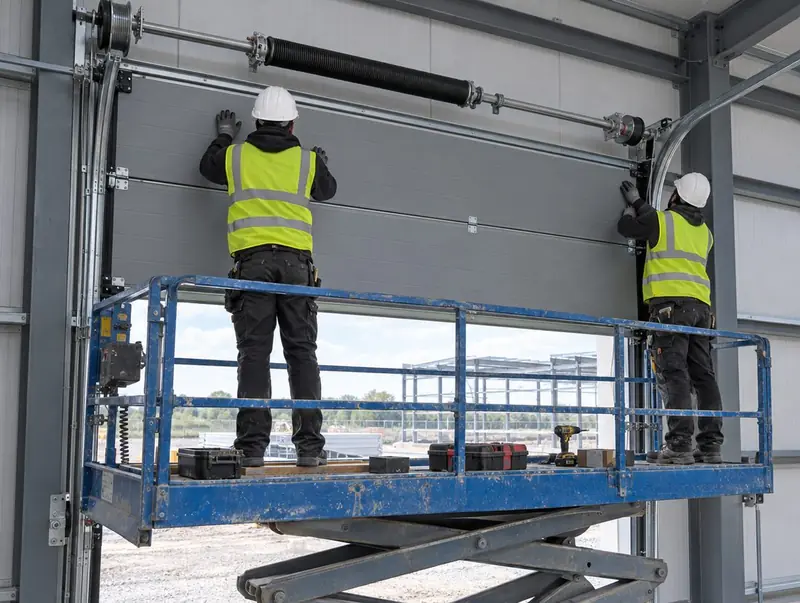
Industrial door installation means surveying an opening, choosing the right door and drive for the way it will be used, then fitting, commissioning and handing it over with the documents the law expects. We install every common type: industrial roller shutters and insulated roller doors, sectional overhead doors, high-speed fabric and spiral doors, fire shutters, sliding and folding doors, hangar doors, cold store doors, steel personnel doors and impact traffic doors.
Doors rarely work alone. A goods-in opening may also need a dock leveller, a shelter, bollards to keep trailers off the guides and a pedestrian door alongside for staff. Because one team surveys the whole opening, the door, the loading equipment and the controls are specified together instead of being left to separate suppliers to sort out the interfaces between them.
Which industrial door suits your opening?
The right door depends on how often the opening is used, what passes through it, how much heat you need to keep in and how much room there is around it.
| Door type | Typical use | Main strength |
|---|---|---|
| Single-skin roller shutter | Yards, stores, unheated units | Compact coil, robust, lower cost |
| Insulated roller door | Heated units with little headroom | Thermal performance in a roller format |
| Sectional overhead door | Loading bays and distribution units | Tight seals, insulation, clear opening |
| High-speed door | Busy internal and external openings | Opens and closes in seconds |
| Fire shutter | Compartment walls, conveyor openings | Closes on alarm to its tested rating |
| Sliding or folding door | Wide openings, farms, low headroom | Nothing coiled or tracked overhead |
If you are weighing up the two most common options, our guide to sectional or roller shutter doors sets out the trade-offs. Where an opening cycles hundreds of times a shift, a high-speed door is usually worth pricing alongside a conventional door.
What do we check on the survey?
The survey checks the opening, the space around it, the structure, the power supply and how the door will be used, and it is free for new doors and replacements. The engineer measures the structural opening and the space around it — headroom above the lintel, side room for guides or tracks and back room into the building — and records anything in the way, such as sprinkler mains, lighting, crane rails, racking, cable trays and roof steelwork.
Just as important is how the door will be used. A door opened twice a day needs very different springs and motors from one cycling every few minutes on a forklift route. Wind exposure matters on tall external doors, which must be specified to resist the loads their location can generate. The engineer also checks the fixing substrate, the floor level across the threshold and where a supply can be brought to a local isolator. Your written fixed price follows the survey, before any work starts.
Who is responsible for safety when a door is powered?
Whoever makes a door powered is responsible for it being safe when it goes into service, and the employer or occupier is responsible for keeping it safe afterwards. Once a door is motorised it is treated as a machine. In Great Britain the Supply of Machinery (Safety) Regulations 2008 apply to whoever puts that machine into service, and an installer who assembles a door from components or adds a motor to a manual door usually becomes its manufacturer in law. That party carries out the risk assessment, compiles the technical file, applies the conformity marking, signs the Declaration of Conformity and supplies user instructions. In Northern Ireland, CE marking under the EU machinery rules continues to apply, and the EU Machinery Regulation 2023/1230 applies directly there from 20 January 2027.
On our installations we take on that role. Powered doors are set up to BS EN 12453, which limits the force a closing door can exert and requires monitored safety functions, and every door is tested before handover. After that, the employer or occupier has the continuing duty to keep it maintained under workplace and work equipment law. Our guide to industrial door safety law explains who owes which duty in each nation.
How long does installation take and what does it cost?
A typical single door is fitted and commissioned in a day once the opening is ready; high-speed doors, fire shutters, hangar doors and full loading bays take longer. Most industrial doors are made to measure, so the manufacturer's lead time usually sets the start date, and we confirm it with the quote.
Guide prices, ex VAT and supplied and fitted, run from £2,395 to £5,495 for an electric single-skin roller shutter up to about 4 × 4 m, and £3,495 to £8,495 for an insulated sectional door up to about 4 × 4.5 m. Size, insulation, glazing, drive type, controls and site access all move the figure. If the door is part of a goods-in opening, our complete loading bay service prices the door, leveller, shelter and protection as one package.
At a glance
- Door types
- Roller shutters, insulated roller, sectional, high-speed, fire, sliding/folding, hangar and cold store doors
- Loading equipment
- Dock levellers, shelters and seals, bollards and guide-rail protection
- Drives
- Manual chain hoist, direct drive, centre drive or chain drive motors, with inverter control on busy doors
- Controls
- Push-button, key switch, remote, induction loop, radar, pull cord, traffic lights and interlocks
- Safety
- Safety edges, photocells, light curtains and fall-protection devices chosen from the risk assessment
- Standards
- Products to BS EN 13241; powered doors set up and force-tested to BS EN 12453
- Handover
- Declaration of Performance, user instructions and commissioning records
- Coverage
- England, Wales, Scotland and Northern Ireland; remote areas and islands by arrangement
Guide prices
| Item | Guide price (ex VAT) |
|---|---|
| Industrial roller shutter, single-skin steel, electric (to c. 4 × 4 m) | £2,395 – £5,495 |
| Sectional overhead door, 40 mm insulated, electric (to c. 4 × 4.5 m) | £3,495 – £8,495 |
| High-speed fabric door | £7,495 – £15,995 |
Guide prices for supply and installation unless stated, excluding VAT, which is added at the current rate where it applies. Your fixed price is confirmed in writing after a survey, before any work starts.
What we check on the survey
- Structural opening size, squareness and floor level across the threshold
- Headroom, side room and back room for coils, tracks or sliding gear
- Overhead and side obstructions: sprinklers, lighting, crane rails, racking, ducts
- Fixing substrate at jambs and head, and any need for new framing
- Power supply route, phase and isolator position
- Daily cycles, vehicle and pedestrian traffic, wind exposure and heating needs
Industrial door installation: frequently asked questions
Do you install on new-build units as well as replacing old doors?
Yes. On new builds we work to the main contractor's programme and the structural opening details on the drawings, confirming dimensions on site before ordering. On replacements we survey the existing opening, include strip-out and disposal of the old door, and price any new framing or making good the opening needs.
Can installation be done without stopping our operations?
Usually. Most single doors are changed within a working day, and we can phase multi-door jobs so only one opening is out of use at a time. Early starts, evenings and weekend working can be arranged where the site needs it, with any extra cost shown in the quote.
Does a new industrial door need planning permission or building regulations approval?
A like-for-like replacement in an existing opening often needs neither, but forming a new opening, changing the appearance of the building or altering a fire-separating door can bring planning or building regulations into play. We flag likely issues at survey; the decision itself rests with the local authority or building control body.
What documents do we receive when the door is handed over?
You receive the manufacturer's Declaration of Performance, user and maintenance instructions, and for powered doors the Declaration of Conformity and records of the commissioning and force tests. Keep them with your site safety files: your maintenance contractor and insurer may ask to see them.
Areas we cover for industrial door installation
We cover England, Wales, Scotland and Northern Ireland; islands and remote sites by arrangement. Choose your area for local details and the law that applies there.
England
- Bedfordshire
- Berkshire
- Bristol
- Buckinghamshire
- Cambridgeshire
- Cheshire
- Cornwall
- County Durham
- Cumbria
- Derbyshire
- Devon
- Dorset
- East Riding of Yorkshire
- East Sussex
- Essex
- Gloucestershire
- Greater London
- Greater Manchester
- Hampshire
- Herefordshire
- Hertfordshire
- Isle of Wight
- Kent
- Lancashire
- Leicestershire
- Lincolnshire
- Merseyside
- Norfolk
- North Yorkshire
- Northamptonshire
- Northumberland
- Nottinghamshire
- Oxfordshire
- Rutland
- Shropshire
- Somerset
- South Yorkshire
- Staffordshire
- Suffolk
- Surrey
- Tyne and Wear
- Warwickshire
- West Midlands
- West Sussex
- West Yorkshire
- Wiltshire
- Worcestershire
Wales
Scotland
- Aberdeen and Aberdeenshire
- Angus and Dundee
- Argyll and Bute
- Ayrshire
- Dumfries and Galloway
- Edinburgh and the Lothians
- Fife
- Forth Valley
- Glasgow
- Highlands and Islands
- Lanarkshire
- Perth and Kinross
- Renfrewshire and Dunbartonshire
- Scottish Borders
Northern Ireland
Last updated 19 October 2026.