
Quick answer
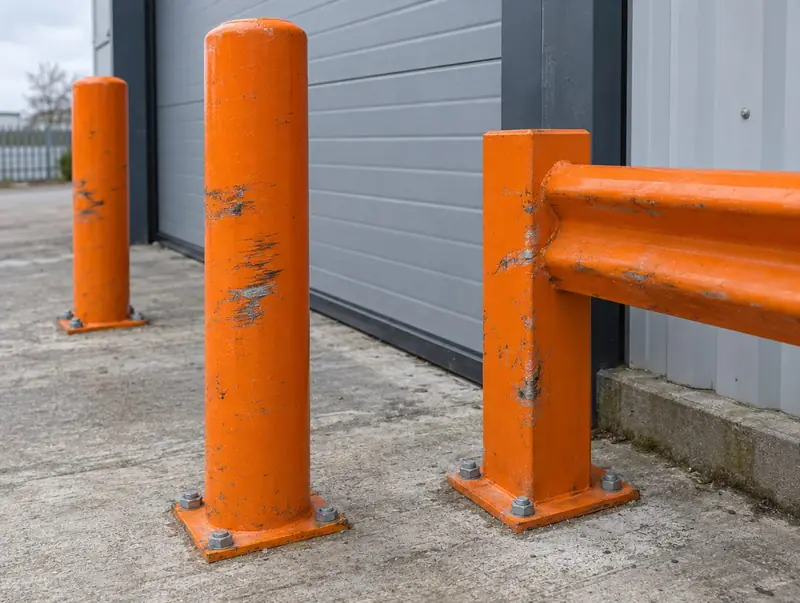
Door protection is equipment fitted around industrial doors and loading bays to stop vehicles hitting the door, its guides or the building: steel or polymer bollards, guide-rail guards, corner buffers, wheel guides and dock bumpers. It is usually far cheaper than repairing a damaged door. Guide prices £125 to £445 ex VAT per installed bollard, and £345 to £1,495 per door for guide-rail guards and buffers.
Why fit bollards and door protection?
Vehicle impact is one of the most common causes of industrial door damage. A forklift catching a guide rail, a lorry reversing into a frame or a trailer pushing past worn bumpers can bend guides, crack panels and distort frames, leaving a door that will not run, will not close or is unsafe to operate. Repairs are disruptive and, on a busy loading bay, the downtime can cost more than the parts.
Protection works by keeping vehicles away from the vulnerable parts of the opening. Bollards stand in front of door guides and frame corners, guards wrap the bottom of the guides, and bumpers stop trailers before they reach the wall. Fitted with a new door or added to existing ones, protection is one of the cheapest ways to keep doors working. If damage has already happened, our industrial door repairs service can put it right first.
Steel or polymer bollards?
Either can be right: steel bollards cost less and stop vehicles rigidly, while polymer bollards flex and absorb the energy of a strike.
- Steel bollards are rigid tubes, often concrete-filled, in galvanised and painted finishes. They stop vehicles firmly but transfer the impact into the floor, so a heavy strike can crack the slab around the fixings or bend the bollard, which then needs replacing.
- Polymer bollards flex on impact and return to shape, absorbing much of the energy. They put less load into the floor, are less likely to damage vehicles and often survive repeated knocks, but they cost more per bollard.
Fixing method matters as much as material. Base-plated bollards bolted to the slab are quick to fit but depend on the strength of the concrete; bollards set in a cored hole or excavated foundation resist heavier impacts. We check the slab and the likely vehicle weights and speeds before recommending either.
How do you protect door guides and frames?
Most door damage happens in the bottom metre or so of the guides, tracks and frame, where forks, pallets and bumpers strike. Steel or polymer guide-rail guards fit over the base of the guides and take the knocks instead. On sectional doors, they also protect the vertical tracks and bottom brackets, where a small dent can stop the door running.
Around the opening, corner and frame buffers in rubber or polymer protect the wall and frame edges at vehicle height. Where forklifts pass through the opening, a pair of bollards inside the building a short distance from each guide often does more than any guard, because it stops the truck before it reaches the door at all. For fast-moving traffic, consider also how the door itself is operated; high-speed doors with breakaway bottom bars cope better with occasional strikes than conventional doors.
Do loading bays need dock bumpers and wheel guides?
Yes. Dock bumpers fixed to the dock face stop the trailer at the right distance from the building, so the shelter seals without being crushed and the leveller lip lands correctly. Worn bumpers let trailers strike the wall, the leveller and the door frame, which is why they should be checked at every leveller service and replaced before they are worn through. Steel-faced and sliding bumpers last longer on heavily used bays.
Wheel guides on the apron steer trailers into the centre of the bay, protecting shelter frames and neighbouring bays. Bollards at the ends of a run of bays protect the corners of the building from swinging trailers. See our complete loading bays page for how protection fits into a full bay design.
How is protection installed and what does it cost?
Most protection is fitted in a few hours per door. Base-plated bollards and guards are drilled and anchored into the slab using fixings suited to the concrete; buried bollards need coring or excavation and concrete, which adds time and is often done out of hours. We check the slab for buried services and underfloor heating before drilling.
Our guide prices are £125 to £445 ex VAT per installed bollard, depending on size, material and fixing, and £345 to £1,495 per door for guide-rail guards and buffers. Dock bumpers and wheel guides are priced on survey alongside any loading bay work. Damaged bollards and guards can usually be replaced individually.
At a glance
- Bollards
- Galvanised and painted steel tube, concrete-filled options, or flexible polymer
- Fixing
- Base-plated and anchor-bolted to the slab, or set in a cored or excavated foundation
- Guide guards
- Steel or polymer guards fitted over the bottom of door guides and tracks
- Buffers
- Rubber or polymer corner and frame buffers at vehicle height
- Dock bumpers
- Laminated or moulded rubber, and steel-faced or sliding bumpers for heavy use
- Wheel guides
- Steel guides on the apron to centre trailers on the bay
- Visibility
- High-visibility yellow or yellow-and-black finish
Guide prices
| Item | Guide price (ex VAT) |
|---|---|
| Bollard, installed | £125 – £445 each |
| Door protection (guide-rail guards, buffers) | £345 – £1,495 per door |
Guide prices for supply and installation unless stated, excluding VAT, which is added at the current rate where it applies. Your fixed price is confirmed in writing after a survey, before any work starts.
What we check on the survey
- Where doors, guides and frames have already been struck
- Vehicle types, weights and speeds around each opening
- Slab thickness, condition and any buried services or heating
- Pedestrian routes and space needed for bollards without blocking access
- Condition of existing dock bumpers and wheel guides
- Visibility and lighting around the opening
Bollards and door protection: frequently asked questions
How far should bollards be from the door?
Far enough that a vehicle hitting the bollard cannot reach the door or guide, but not so far that they block the opening or pedestrian routes. The right distance depends on vehicle types and how the bollard behaves on impact. We set positions on survey after looking at how vehicles approach each door.
Will bollards damage our floor?
A heavy strike on a rigid base-plated bollard can crack the slab around the fixings. Polymer bollards, which flex, and bollards set in a proper foundation reduce that risk. We check the slab on survey and recommend a fixing method to suit it.
Can protection be added to existing doors?
Yes. Most guards, buffers and bollards are designed to retrofit around existing doors and frames. If a guide or frame is already damaged, it is worth repairing it first so the protection is fitted to a sound, straight door.
How often should dock bumpers be replaced?
When they are worn, split or no longer hold trailers at the correct distance. On busy bays that can be every few years or sooner. Check them at each leveller service: worn bumpers lead quickly to damaged levellers, shelters and walls.
Areas we cover for bollards and door protection
We cover England, Wales, Scotland and Northern Ireland; islands and remote sites by arrangement. Choose your area for local details and the law that applies there.
England
- Bedfordshire
- Berkshire
- Bristol
- Buckinghamshire
- Cambridgeshire
- Cheshire
- Cornwall
- County Durham
- Cumbria
- Derbyshire
- Devon
- Dorset
- East Riding of Yorkshire
- East Sussex
- Essex
- Gloucestershire
- Greater London
- Greater Manchester
- Hampshire
- Herefordshire
- Hertfordshire
- Isle of Wight
- Kent
- Lancashire
- Leicestershire
- Lincolnshire
- Merseyside
- Norfolk
- North Yorkshire
- Northamptonshire
- Northumberland
- Nottinghamshire
- Oxfordshire
- Rutland
- Shropshire
- Somerset
- South Yorkshire
- Staffordshire
- Suffolk
- Surrey
- Tyne and Wear
- Warwickshire
- West Midlands
- West Sussex
- West Yorkshire
- Wiltshire
- Worcestershire
Wales
Scotland
- Aberdeen and Aberdeenshire
- Angus and Dundee
- Argyll and Bute
- Ayrshire
- Dumfries and Galloway
- Edinburgh and the Lothians
- Fife
- Forth Valley
- Glasgow
- Highlands and Islands
- Lanarkshire
- Perth and Kinross
- Renfrewshire and Dunbartonshire
- Scottish Borders
Northern Ireland
Last updated 19 October 2026.