Quick answer
A sectional overhead door is an industrial door made of hinged, insulated steel panels that run on side tracks, lifting vertically and then back under the roof. It seals well, insulates better than most roller shutters and suits busy loading bays. Guide price £3,495 to £8,495 ex VAT supplied and fitted, electric, up to about 4 × 4.5 m.
What is a sectional overhead door?
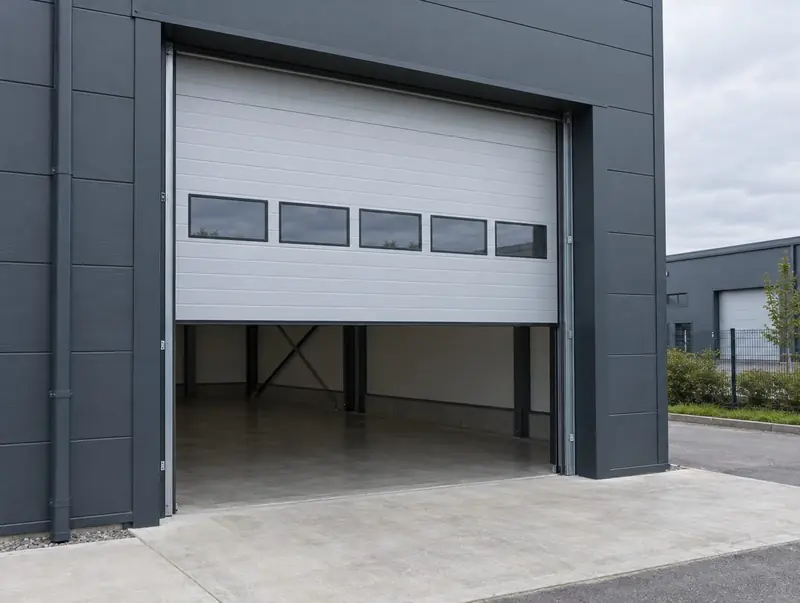
A sectional overhead door is a door built from horizontal steel sandwich panels, usually 40 mm thick with polyurethane foam between the skins, hinged together and carried on rollers in side tracks. When it opens, the panels rise vertically and then turn to run horizontally under the roof, so nothing projects outside the building and the opening stays fully clear.
Because each panel has rubber seals at the joints and a brush or rubber seal at the sides, head and floor, a well-installed sectional door keeps out draughts, rain and noise far better than a single-skin shutter. That is why it has become the standard choice on new distribution centres and on any unit where heating bills matter.
Which track type does your building need?
The track decides how much space the door takes inside the building. On a survey we measure headroom (opening head to the lowest obstruction above), side room and the depth back into the building, then pick from four layouts:
- Standard lift — panels turn just above the opening and run under the roof. Needs roughly 450–500 mm of headroom.
- Low headroom — a double-track arrangement for tight units where steelwork, sprinklers or ducts sit close to the opening.
- High lift — the panels rise further up the wall before turning, keeping the door clear of overhead cranes, lighting and racking.
- Vertical lift — the door runs straight up the wall. Best where the roof space must stay completely free, but it needs a tall building.
Getting this wrong is the most common reason a sectional door fouls lights, sprinkler heads or a crane rail, so we check every obstruction before ordering.
Manual or electric operation?
Smaller doors that open a few times a day can run on balanced torsion springs with a chain hoist. Anything opening more than a handful of times a shift is worth motorising: a shaft-mounted motor saves time, keeps the door used properly and lets you add remote controls, induction loops or radar activation.
For high-cycle loading bays, a frequency-inverter drive opens faster and slows gently at each end, which reduces wear on rollers, hinges and springs. Electric doors need a suitable supply to a local isolator — usually provided by your electrician — and the motor size dictates whether that is single or three phase.
How is a sectional door installed?
Most single doors are fitted in one day once the opening is ready. The team checks the opening is square and the jambs and head are strong enough to fix to, fits the tracks and spring shaft, builds the curtain panel by panel, tensions the springs, then fits and commissions the motor and safety devices.
Before handover the door is force-tested and its safety functions checked, and you receive the user instructions, the manufacturer's Declaration of Performance, and, for powered doors, the conformity documentation and a record of the commissioning checks. Replacement jobs add strip-out of the old door and, often, new steel or timber framing to the opening.
What affects the price?
Size is the biggest driver, followed by panel thickness, the number of glazed sections, the track type and whether a wicket door is included. Electric operation, inverter drives, light curtains and access controls add to the cost. Site factors matter too: working at height over racking, out-of-hours installation, making good the opening and removing an old door. Our written quote lists each item so you can compare like with like. See sectional or roller shutter if you are still deciding on the door type.
At a glance
- Panels
- 40 mm PU-insulated steel as standard; 60–80 mm thermal panels on request
- Lift types
- Standard, high lift, vertical lift or low headroom track
- Glazing
- Vision panel rows, full-vision aluminium sections or none
- Operation
- Manual chain, shaft-mounted electric motor or frequency-inverter drive
- Pass door
- Integrated wicket door with low threshold option
- Safety
- Spring-break and cable-break devices, safety edge, photocells or light curtain
- Finish
- Standard RAL colours, woodgrain or stucco embossed outer skin
- Marking
- Manufacturer's CE or UKCA marking and Declaration of Performance to BS EN 13241
Guide prices
| Item | Guide price (ex VAT) |
|---|---|
| Sectional overhead door, 40 mm insulated, electric (to c. 4 × 4.5 m) | £3,495 – £8,495 |
| Strip-out and disposal on replacement | £345 – £1,195 per door |
Guide prices for supply and installation unless stated, excluding VAT, which is added at the current rate where it applies. Your fixed price is confirmed in writing after a survey, before any work starts.
What we check on the survey
- Clear opening width and height, and floor level across the opening
- Headroom, side room and back room for the track layout
- Obstructions above: sprinklers, lights, ducts, crane rails, racking
- Fixing quality of jambs and head (steel, block, timber)
- Power supply position and phase, and control preferences
- Daily cycle count, wind exposure and pedestrian routes nearby
Sectional overhead doors: frequently asked questions
How long does a sectional overhead door last?
With servicing at least once a year, a good sectional door typically gives many years of use. Springs are rated in cycles, so a busy loading bay may need new springs well before the panels show their age. Specifying higher-cycle springs at order stage costs a little more and pays back on doors that open dozens of times a day.
Can a sectional door have a pedestrian door built in?
Yes. Most manufacturers offer an integrated wicket door within the panels, with a low-threshold version that reduces the trip hazard. A wicket door adds cost and weight, and on some door sizes a separate steel personnel door beside the sectional door is the better option. We advise on this at survey.
Are sectional doors more secure than roller shutters?
A standard sectional door is reasonably robust, but neither door type is security rated unless the product is certified to a scheme such as LPS 1175. If your insurer asks for a rating, we supply a door whose manufacturer holds that certification and install it to the certified specification.
Do you replace springs and panels on existing sectional doors?
Yes. We repair most makes of sectional door, including spring and cable replacement, damaged panel replacement, roller and hinge renewal and motor changes, subject to parts being available. A broken spring should only be dealt with by a trained engineer because of the stored energy involved.
Areas we cover for sectional overhead doors
We cover England, Wales, Scotland and Northern Ireland; islands and remote sites by arrangement. Choose your area for local details and the law that applies there.
England
- Bedfordshire
- Berkshire
- Bristol
- Buckinghamshire
- Cambridgeshire
- Cheshire
- Cornwall
- County Durham
- Cumbria
- Derbyshire
- Devon
- Dorset
- East Riding of Yorkshire
- East Sussex
- Essex
- Gloucestershire
- Greater London
- Greater Manchester
- Hampshire
- Herefordshire
- Hertfordshire
- Isle of Wight
- Kent
- Lancashire
- Leicestershire
- Lincolnshire
- Merseyside
- Norfolk
- North Yorkshire
- Northamptonshire
- Northumberland
- Nottinghamshire
- Oxfordshire
- Rutland
- Shropshire
- Somerset
- South Yorkshire
- Staffordshire
- Suffolk
- Surrey
- Tyne and Wear
- Warwickshire
- West Midlands
- West Sussex
- West Yorkshire
- Wiltshire
- Worcestershire
Wales
Scotland
- Aberdeen and Aberdeenshire
- Angus and Dundee
- Argyll and Bute
- Ayrshire
- Dumfries and Galloway
- Edinburgh and the Lothians
- Fife
- Forth Valley
- Glasgow
- Highlands and Islands
- Lanarkshire
- Perth and Kinross
- Renfrewshire and Dunbartonshire
- Scottish Borders
Northern Ireland
Last updated 19 October 2026.