Quick answer
A cold store door is a heavily insulated door built to seal a chilled or frozen room, with compressible gaskets, a heated frame on freezer versions to stop the seals icing up, and an inside release so nobody can be trapped. Sliding doors suit most pallet and forklift openings; hinged and high-speed versions suit other traffic. Guide price £6,495 to £17,995 ex VAT for a sliding cold store or freezer door.
What makes a cold store door different?
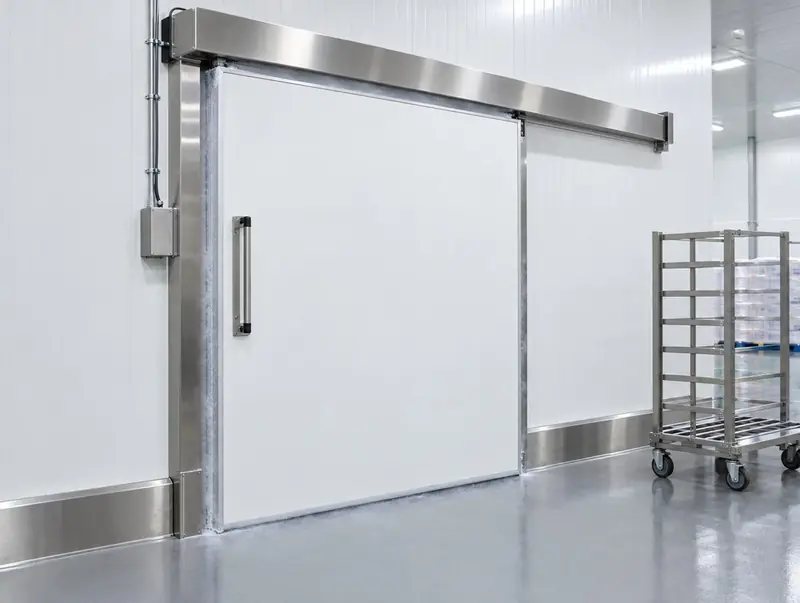
A cold store door is designed to hold a large temperature difference across it without losing cold air, admitting warm moist air or freezing shut. Leaves are thick, foam-filled and built with as few thermal bridges as possible, and the door is designed to press its gaskets tight against the frame when it closes, typically by dropping or moving inwards on its track at the end of travel.
Freezer doors add a heated frame. Low-voltage heater cables run around the frame and often under the threshold, keeping the gasket faces just above freezing so ice cannot form and weld the door shut. Without that heat, moisture from warm air entering the store freezes on the seals within hours, the door stops sealing and the refrigeration plant works harder to compensate.
Sliding, hinged or high-speed?
The door type follows the traffic and the size of the opening.
- Sliding cold store doors are the standard for pallet and forklift traffic. The leaf runs on a top track and seals onto the frame when closed. They can be manual or electric, with pull cords, radar or loops to open them.
- Hinged doors suit pedestrian access and smaller rooms, such as walk-in chillers in kitchens and food production.
- High-speed cold store doors sit on very busy openings, often alongside or in front of a sliding door, with insulated curtains and heated guides on freezer versions. See our high-speed doors page for the main ranges.
On busy openings, an insulated sliding door that closes overnight combined with a high-speed door or strip curtain for daytime traffic is often the most practical arrangement. Vision panels in the leaf, heated on freezer doors to stop them fogging, help drivers see whether anyone is on the other side.
Why does a cold store need pressure relief?
When a cold store door closes, warm air that entered the room cools and contracts, pulling the room into negative pressure. In a well-sealed freezer that suction can be strong enough to make the door very hard to open and can distort insulated panels. Defrost cycles cause the opposite problem by warming and expanding the air.
A pressure relief valve, usually heated on freezer rooms, lets air in or out to balance the pressure. It may sit in the wall panels or be built into the door, and its sizing depends on the room volume and refrigeration design. We check whether relief is already provided when we survey, as a new well-sealing door can expose a problem that a leaky old door was masking. The valve's own heater and vents need checking at each service, because an iced-up valve stops working without any obvious sign.
What safety features must a cold store door have?
Every cold store door needs a way to be opened from inside without a key or tool, even if it has been locked from outside, so nobody can be trapped. That is typically a large push-button or mushroom-head release on the inside face of the leaf, clearly marked and lit. Many sites also fit an alarm button inside the store connected to a monitored panel.
Powered sliding doors need the same protection as any other powered door: limited closing forces, safety edges on the closing leaf and photocells across the opening, set up to BS EN 12453 and recorded at commissioning. Floors near freezer doors can be icy, and leaves are heavy, so the risk assessment should also cover slips, impacts and pedestrian routes. Our cold store door guide covers these points in more detail.
What affects price and installation?
Our guide price for a sliding cold store or freezer door is £6,495 to £17,995 ex VAT, supplied and fitted. Size, insulation thickness, operating temperature, electric operation, heated frames and thresholds, vision panels and hygienic finishes all affect the figure. Replacement jobs may also involve cutting or making good the insulated panels around the opening.
Installation is planned around your stock and refrigeration. A door can often be changed in a day, but freezer rooms may need to be emptied or the plant set back, and the frame heater needs a suitable supply. We agree the sequence with you and your refrigeration engineer so the room is back at temperature as quickly as possible.
At a glance
- Door types
- Sliding (manual or electric), hinged, double-acting, vertical-lift and high-speed cold store doors
- Insulation
- Polyurethane-filled leaves, typically 80–150 mm or more depending on room temperature
- Seals
- Compressible gaskets on all edges, with the leaf pulled tight against the frame on closing
- Frame heating
- Low-voltage heater cables in the frame and threshold of freezer doors to stop ice forming
- Safety
- Inside emergency release, so the door can always be opened from within
- Pressure
- Pressure relief valve in the room or door to equalise pressure after closing
- Hygiene
- Food-safe finishes such as plastisol-coated steel, stainless steel or GRP
- Protection
- Kick plates, buffers and bollards to protect leaves and frames from trucks
Guide prices
| Item | Guide price (ex VAT) |
|---|---|
| Cold store / freezer door (sliding) | £6,495 – £17,995 |
| High-speed fabric door | £7,495 – £15,995 |
Guide prices for supply and installation unless stated, excluding VAT, which is added at the current rate where it applies. Your fixed price is confirmed in writing after a survey, before any work starts.
What we check on the survey
- Room operating temperature and the temperature on the warm side
- Opening size and the panel or wall construction around it
- Traffic: pedestrians, pallet trucks, forklifts and cycles per shift
- Existing pressure relief and frame heating arrangements
- Hygiene requirements and preferred finish for food or pharmaceutical use
- Power supplies for drive and heaters, and access for installation
Cold store and freezer doors: frequently asked questions
Why does my freezer door keep icing up?
Usually because warm, moist air is getting past worn or damaged seals, the frame heater has failed, or the door is left open too long. Ice then builds on the gaskets and stops the door sealing. Check the heater is working and the gaskets are intact; if the door is old, replacement may be the more reliable fix.
Can a cold store door be electric?
Yes. Sliding cold store doors are commonly motorised, opened by pull cord, push-button, radar or induction loop and closing automatically after a set time. Powered doors need safety edges and photocells, and the drive is chosen to cope with the low temperatures it may see.
Do you supply hygienic doors for food production?
Yes. We supply cold store doors with food-safe finishes such as plastisol-coated steel, stainless steel or GRP, with smooth surfaces and seals designed for regular cleaning. Your hygiene and audit requirements are discussed at survey.
Can a strip curtain be fitted behind a cold store door?
Yes, and it is common practice. A strip curtain inside the door cuts the cold air lost while the main door is open, especially on manual doors left open during loading. Freezer-grade PVC strips stay flexible at low temperatures.
Areas we cover for cold store and freezer doors
We cover England, Wales, Scotland and Northern Ireland; islands and remote sites by arrangement. Choose your area for local details and the law that applies there.
England
- Bedfordshire
- Berkshire
- Bristol
- Buckinghamshire
- Cambridgeshire
- Cheshire
- Cornwall
- County Durham
- Cumbria
- Derbyshire
- Devon
- Dorset
- East Riding of Yorkshire
- East Sussex
- Essex
- Gloucestershire
- Greater London
- Greater Manchester
- Hampshire
- Herefordshire
- Hertfordshire
- Isle of Wight
- Kent
- Lancashire
- Leicestershire
- Lincolnshire
- Merseyside
- Norfolk
- North Yorkshire
- Northamptonshire
- Northumberland
- Nottinghamshire
- Oxfordshire
- Rutland
- Shropshire
- Somerset
- South Yorkshire
- Staffordshire
- Suffolk
- Surrey
- Tyne and Wear
- Warwickshire
- West Midlands
- West Sussex
- West Yorkshire
- Wiltshire
- Worcestershire
Wales
Scotland
- Aberdeen and Aberdeenshire
- Angus and Dundee
- Argyll and Bute
- Ayrshire
- Dumfries and Galloway
- Edinburgh and the Lothians
- Fife
- Forth Valley
- Glasgow
- Highlands and Islands
- Lanarkshire
- Perth and Kinross
- Renfrewshire and Dunbartonshire
- Scottish Borders
Northern Ireland
Last updated 19 October 2026.