
Quick answer
Fire shutter servicing is a planned inspection, maintenance and closure test that proves a fire shutter will close fully and safely when the fire alarm releases it. It is usually done at least once a year, often every six months, and recorded for the fire risk assessment. Guide price £125 to £265 ex VAT per shutter per visit.
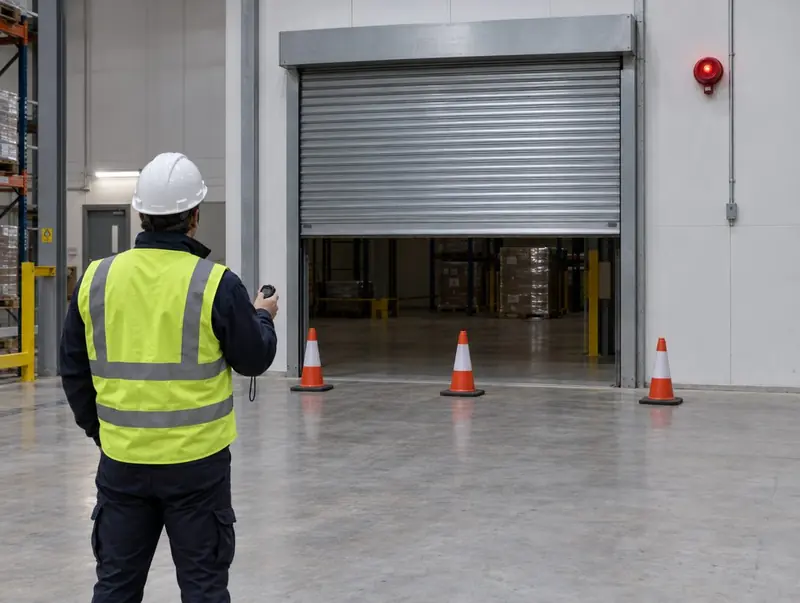
Why do fire shutters need regular testing?
A fire shutter spends almost all of its life open and unused, so the parts that matter in a fire — the release mechanism, the governor that controls its speed and the guides it runs in — can seize, drift out of adjustment or be blocked without anyone noticing. Regular servicing with a closure test is the only way to know the shutter will drop when the alarm signals it.
Fire safety law places the duty on the person in control of the premises: the responsible person in England and Wales, the dutyholder in Scotland and, in Northern Ireland, the person with fire safety duties (often called the appropriate person). Fire safety facilities and equipment, including fire shutters, must be maintained in efficient working order and good repair. Keeping test records is good practice that supports the fire risk assessment, and your assessor will expect to see them.
How often should a fire shutter be serviced?
Follow the manufacturer's instructions and your fire risk assessment. Industry practice is a full service with a closure test at least once a year, and every six months on busy sites or where the shutter is also used daily as a working door. Between services, the responsible person or a trained member of staff should carry out routine checks: nothing stored in the closing line, guides undamaged and the control panel showing normal.
What happens during a service visit?
- Agree the test with you and your alarm contractor, isolate as needed and cone off the closing path.
- Inspect the curtain, barrel, guides, bottom rail and seals for damage, corrosion and obstruction.
- Check the motor, brake, limits and any battery back-up.
- Trigger the release, as the alarm would, and time the descent against the manufacturer's figures.
- Confirm the shutter closes fully and squarely, then reset and test normal operation.
- Record findings, photographs and any remedial work needed.
Where the shutter is released by the fire alarm (an interface commonly designed using BS 7273-4, the code for door release mechanisms), the alarm engineer is usually needed to prove the signal path. We coordinate the visit so both checks happen together.
What if the shutter fails?
If a shutter does not close fully, closes too fast or cannot be reset, we tell you on the day and explain the risk in writing. Common causes are a seized governor, a damaged lath, a failed battery or a blocked guide. Many faults are fixed on the visit; others need parts, and we quote before doing chargeable repairs. Your fire risk assessor should be told about any shutter that is out of action so interim measures can be considered.
Do you service shutters you did not install?
Yes. We service most makes of fire shutter. On a first visit we record each shutter's make, rating label, size and control type, and flag anything that looks modified from its certified specification — a fire shutter only performs as tested when it is kept to the manufacturer's design. Read our guide to fire shutter testing and maintenance for more detail.
At a glance
- Visit
- Inspection, lubrication, adjustment and full closure test
- Release
- Alarm-signal release and fail-safe closing checked with the alarm contractor
- Closing speed
- Governed descent checked against the manufacturer's range
- Seals and smoke
- Bottom rail, guides and smoke seals inspected
- Reset
- Shutter reset and returned to normal operation after the test
- Records
- Written service report per shutter for your fire safety logbook
- Makes
- Most fire shutter brands, subject to parts availability
Guide prices
| Item | Guide price (ex VAT) |
|---|---|
| Fire shutter service with drop test, per shutter | £125 – £265 |
| Repair visit (attendance and first hour) | £145 – £195 |
Guide prices excluding VAT, which is added at the current rate where it applies. The visit price is agreed before we attend, and any repair is quoted before we carry it out.
What we check on a visit
- Number, location and make of each fire shutter
- Fire resistance label and manufacturer details on the shutter
- How each shutter is released: alarm interface, fusible link or both
- Access to the closing line during the test and any out-of-hours needs
- Alarm contractor contact for coordinated testing
- Previous service records and known faults
Fire shutter servicing and drop tests: frequently asked questions
Is fire shutter servicing a legal requirement?
The law requires fire safety equipment to be maintained in efficient working order and good repair. Keeping service records is good practice that supports the fire risk assessment. In England and Wales that duty sits with the responsible person under the Regulatory Reform (Fire Safety) Order 2005; Scotland and Northern Ireland have equivalent duties.
What is a fire shutter drop test?
A drop test releases the shutter as the fire alarm would and lets it descend under its own fail-safe mechanism. The engineer checks that it closes fully, squarely and at a controlled speed, then resets it. It is the key part of any fire shutter service.
Can you test our shutters out of hours?
Yes. Testing means closing the opening, so many sites prefer early mornings, evenings or weekends. Out-of-hours visits can be arranged, and the price for them is confirmed in the quote.
Will I get a certificate after the service?
You receive a written service report for each shutter recording what was checked, the test result, any defects and recommended actions. It is evidence of maintenance for your fire safety records; it does not re-certify the shutter, whose fire rating comes from the manufacturer's tested design.
Areas we cover for fire shutter servicing and drop tests
We cover England, Wales, Scotland and Northern Ireland; islands and remote sites by arrangement. Choose your area for local details and the law that applies there.
England
- Bedfordshire
- Berkshire
- Bristol
- Buckinghamshire
- Cambridgeshire
- Cheshire
- Cornwall
- County Durham
- Cumbria
- Derbyshire
- Devon
- Dorset
- East Riding of Yorkshire
- East Sussex
- Essex
- Gloucestershire
- Greater London
- Greater Manchester
- Hampshire
- Herefordshire
- Hertfordshire
- Isle of Wight
- Kent
- Lancashire
- Leicestershire
- Lincolnshire
- Merseyside
- Norfolk
- North Yorkshire
- Northamptonshire
- Northumberland
- Nottinghamshire
- Oxfordshire
- Rutland
- Shropshire
- Somerset
- South Yorkshire
- Staffordshire
- Suffolk
- Surrey
- Tyne and Wear
- Warwickshire
- West Midlands
- West Sussex
- West Yorkshire
- Wiltshire
- Worcestershire
Wales
Scotland
- Aberdeen and Aberdeenshire
- Angus and Dundee
- Argyll and Bute
- Ayrshire
- Dumfries and Galloway
- Edinburgh and the Lothians
- Fife
- Forth Valley
- Glasgow
- Highlands and Islands
- Lanarkshire
- Perth and Kinross
- Renfrewshire and Dunbartonshire
- Scottish Borders
Northern Ireland
Last updated 19 October 2026.