Quick answer
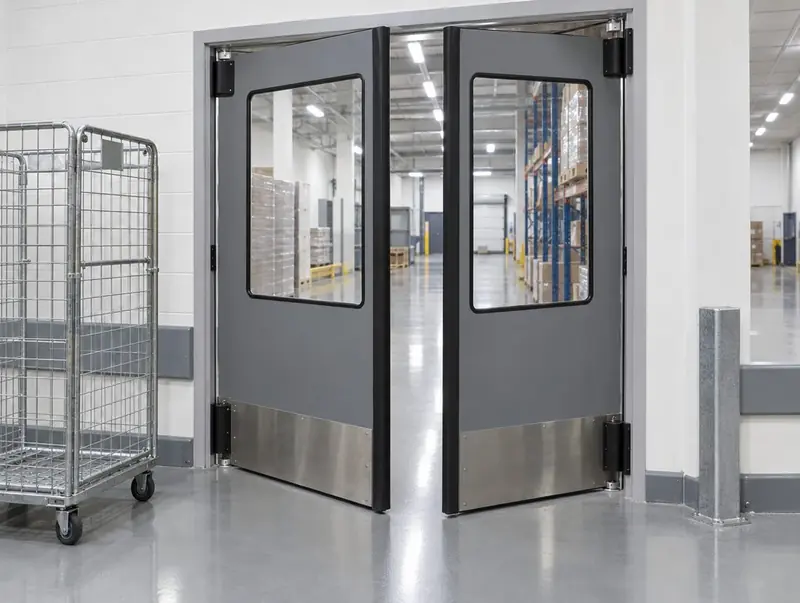
An impact traffic door is a double-acting swing door made to be pushed open by a trolley, pallet truck or person and to close itself behind them, absorbing knocks without damage. Leaves are typically polyethylene, rubber or stainless-faced, on gravity or spring hinges, often with vision panels. They suit warehouses, kitchens, food production and retail back-of-house. Guide price £895 to £2,495 ex VAT per pair, supplied and fitted.
What is an impact traffic door?
An impact traffic door is a double-acting swing door built to be pushed open by whatever is passing through it, then to swing back and close on its own. Unlike an ordinary hinged door, it is designed to take repeated knocks from trolleys, roll cages and pallet trucks, so the leaves flex or absorb the impact instead of denting, cracking or tearing the hinges out of the wall.
Traffic doors are used where people and light vehicles move constantly between areas but a full door would slow them down: between a shop floor and its stockroom, kitchens and restaurants, food production areas, hospital service corridors and warehouse picking zones. They cut draughts, dust, noise and odour without needing anyone to stop and open a door by hand.
Which leaf material should you choose?
Leaf material decides how the door copes with impacts, cleaning and temperature.
- Polyethylene is tough, light and fully washable, and suits most warehouse and food applications.
- Rubber leaves flex further on impact and recover, which suits heavy trolley and pallet truck traffic.
- Insulated leaves have a foam core between plastic skins to help hold temperature in chilled areas.
- Stainless steel or aluminium-faced leaves give a hard, hygienic finish for kitchens and front-of-house settings where appearance matters.
Most leaves include clear vision panels so people on each side can see each other before the door opens. Kick plates and bumper strips at trolley height take the worst of the wear and can be renewed without replacing the leaf.
Gravity or spring hinges?
Gravity hinges suit most leaves and give a gentle, controlled close; spring hinges suit lighter leaves and close more firmly. How the leaves return to centre affects how the door feels to use and how long it lasts. Gravity hinges use a rising cam: as the leaf opens it lifts slightly, and its own weight swings it back down to the closed position. They are simple, have few parts to wear and give a gentle, controlled closing action. Spring hinges use a sprung mechanism to return the leaf, suit lighter leaves and give a firmer close.
Hinge choice depends on leaf weight, traffic and how quickly the door must close after each pass. On survey we check the frame or wall each leaf will hang from, because repeated impacts put real loads through the fixings. Weak block or plasterboard partitions may need a steel frame or reinforcement before the doors go in. We also check the floor is level across the opening, since a slope makes gravity-hinged leaves sit open or close unevenly.
When is a traffic door better than a strip curtain or high-speed door?
A traffic door is the better choice on pedestrian and trolley routes where hygiene, appearance or a better seal matters but a powered door would be more than the opening needs. Compared with a PVC strip curtain, a pair of traffic doors gives a cleaner look, a better seal, easier cleaning and no strips to brush past or get caught on loads, which suits food and retail back-of-house areas. Compared with a high-speed door, traffic doors need no power, controls or sensors and cost far less, but they rely on the vehicle pushing through and are not suited to forklifts or very heavy traffic.
For heavy forklift routes or openings where temperature control really matters, a high-speed door is usually the better answer. Our guide to strip curtains and high-speed doors compares the options in more detail.
How are traffic doors fitted and what do they cost?
Traffic doors are made to the opening size, then hung from frames fixed to the wall or to a steel subframe. Fitting usually takes a few hours per pair: fixing the frames, mounting the hinges, hanging and levelling the leaves, setting the closing action and fitting kick plates or bumpers. The work causes little disruption and can often be done between shifts.
Our guide price is £895 to £2,495 ex VAT for a pair, supplied and fitted. Leaf material, thickness, size, insulation, vision panels and stainless finishes all affect the price. Damaged leaves, worn hinges and missing kick plates can usually be replaced individually, which keeps running costs down on busy routes. Where trolleys repeatedly strike the frame rather than the leaves, steel buffers or corner guards either side of the opening are a cheap way to protect the wall.
At a glance
- Leaf materials
- Polyethylene, rubber, insulated PE, stainless steel or aluminium-faced
- Action
- Double-acting, opening both ways and self-closing to centre
- Hinges
- Rising-cam gravity hinges or spring hinges, matched to leaf weight
- Vision
- Clear polycarbonate or PVC vision panels at eye level
- Protection
- Kick plates, bumper strips and wear guards on the push face
- Insulation
- Insulated leaves for chillers and temperature-controlled areas
- Hygiene
- Smooth, cleanable surfaces suited to food and pharmaceutical areas
Guide prices
| Item | Guide price (ex VAT) |
|---|---|
| Impact traffic doors, pair | £895 – £2,495 |
| PVC strip curtain, per doorway | £175 – £895 |
Guide prices for supply and installation unless stated, excluding VAT, which is added at the current rate where it applies. Your fixed price is confirmed in writing after a survey, before any work starts.
What we check on the survey
- Opening width and height, and the condition of the wall or frame either side
- Traffic type: pedestrians, trolleys, roll cages, pallet trucks
- Temperature difference and any need for insulated leaves
- Hygiene and cleaning requirements for the area
- Vision panel height and position for people on both sides
- Floor level across the opening and clearance under the leaves
Impact traffic doors: frequently asked questions
Can forklifts use impact traffic doors?
Traffic doors are designed for pedestrians, trolleys and pallet trucks. Forklifts are generally too heavy and fast for them and tend to damage leaves and fixings quickly. On forklift routes, a high-speed door or strip curtain is usually a better choice.
Are impact traffic doors suitable for food areas?
Yes. Polyethylene, insulated and stainless steel leaves have smooth, cleanable surfaces suited to food production, kitchens and supermarket back-of-house areas. We discuss your hygiene and cleaning regime at survey before recommending a material.
Can damaged leaves be replaced individually?
Usually, yes. Leaves, hinges, kick plates and vision panels can be replaced separately, provided the door model is still supported. Replacing worn parts promptly keeps the door closing properly and stops damage spreading to the frame.
Do impact traffic doors help with temperature control?
They reduce draughts and help separate temperature zones, especially with insulated leaves. They are not a substitute for a proper cold store door on chillers and freezers, but they work well between areas with modest temperature differences.
Areas we cover for impact traffic doors
We cover England, Wales, Scotland and Northern Ireland; islands and remote sites by arrangement. Choose your area for local details and the law that applies there.
England
- Bedfordshire
- Berkshire
- Bristol
- Buckinghamshire
- Cambridgeshire
- Cheshire
- Cornwall
- County Durham
- Cumbria
- Derbyshire
- Devon
- Dorset
- East Riding of Yorkshire
- East Sussex
- Essex
- Gloucestershire
- Greater London
- Greater Manchester
- Hampshire
- Herefordshire
- Hertfordshire
- Isle of Wight
- Kent
- Lancashire
- Leicestershire
- Lincolnshire
- Merseyside
- Norfolk
- North Yorkshire
- Northamptonshire
- Northumberland
- Nottinghamshire
- Oxfordshire
- Rutland
- Shropshire
- Somerset
- South Yorkshire
- Staffordshire
- Suffolk
- Surrey
- Tyne and Wear
- Warwickshire
- West Midlands
- West Sussex
- West Yorkshire
- Wiltshire
- Worcestershire
Wales
Scotland
- Aberdeen and Aberdeenshire
- Angus and Dundee
- Argyll and Bute
- Ayrshire
- Dumfries and Galloway
- Edinburgh and the Lothians
- Fife
- Forth Valley
- Glasgow
- Highlands and Islands
- Lanarkshire
- Perth and Kinross
- Renfrewshire and Dunbartonshire
- Scottish Borders
Northern Ireland
Last updated 19 October 2026.