Quick answer
Door automation for warehouses, workshops and loading bays in Newtownabbey. We convert manual doors to electric, fit motors and control panels, and add loops, radar, remotes and interlocks to suit how each door is used.
- Town
- Newtownabbey
- Postcode district
- BT37
- Area
- Antrim
- Survey
- Free for new installations
What to specify
- Interlocks. Doors linked to each other, to levellers or to the alarm so they work in the right sequence.
- Manual override. A manual means of opening is always kept, so the door is never stuck shut without power.
- Inverter drives. Soft start and stop with faster opening for high-cycle doors.
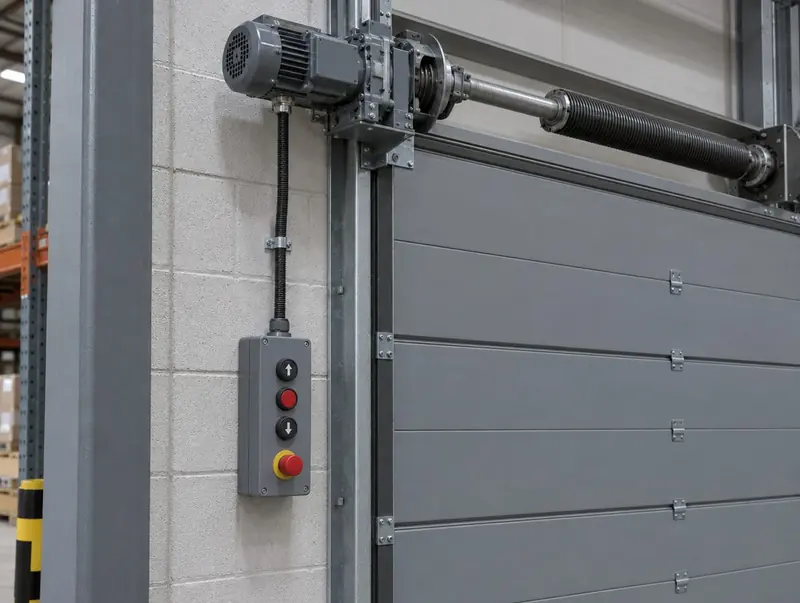
- Matched motors. The motor type and size are chosen for the door's weight, space and cycle count.
- Traffic lights. Signals show drivers when the door is fully open and warn when it moves.
What this work can involve
- Fitting a centre-mounted motor to a roller shutter where a side wall leaves no room at the barrel end.
- Replacing an obsolete control panel with a modern unit, then re-testing the safety devices and closing forces.
- Fitting induction loops and an inverter control panel so forklifts can open a busy internal door without stopping.
Who is responsible for door safety at a site in Newtownabbey?
In Northern Ireland, the business in control of the premises must keep doors and gates safe under the Workplace Regulations (Northern Ireland) 1993 and maintain work equipment under PUWER (Northern Ireland) 1999, with HSENI as the regulator. The installer who supplies or motorises a door hands over the conformity documents and user instructions; CE marking remains the relevant mark for machinery here.
How the work is organised
Before work starts we send a method statement and risk assessment, confirm who on site will be our contact and agree where materials and access equipment will go. On shared industrial estates that can mean booking yard space with the landlord.
Budgeting for door automation and controls in Newtownabbey
| Item | Guide price (ex VAT) |
|---|---|
| Manual-to-electric conversion | £1,195 – £3,195 |
| Safety upgrade (edges, photocells, light curtain) | £445 – £1,795 per door |
Guide prices for supply and installation unless stated, excluding VAT, which is added at the current rate where it applies. Your fixed price is confirmed in writing after a survey, before any work starts.
Frequently asked questions
How long does a door automation job take in Newtownabbey?
A straightforward conversion is usually completed and commissioned in a day. Loops, interlocks and traffic lights add time, and we plan the work so the door is out of use for as little time as possible.
Can you add interlocks or traffic lights to doors around County Antrim?
Yes. We fit airlock interlocks, door-to-leveller interlocks, traffic lights and warning beacons to new and existing doors across County Antrim, subject to compatibility with the control panels already fitted, and replace panels where they cannot accept the extra inputs.
How much does it cost to make a door electric in Newtownabbey?
Our guide price for a manual-to-electric conversion is £1,195 to £3,195 ex VAT, including motor, control panel, basic controls and commissioning. Extra controls and safety devices are priced separately, and your fixed price in Newtownabbey follows a free survey.
Door automation and controls near Newtownabbey
Our teams cover Newtownabbey (BT37) and nearby Belfast, Carrickfergus, Bangor (Down), along with the rest of County Antrim.
- Door automation and controls in Belfast
- Door automation and controls in Carrickfergus
- Door automation and controls in Bangor (Down)
- Door automation and controls in Newtownards
- Door automation and controls in Lisburn
- Door automation and controls in Antrim
Other services in Newtownabbey
- Impact traffic doors
- Dock leveller and loading bay repairs
- Industrial door motor replacement
- Door safety upgrades
- Bollards and door protection
- High-speed doors
- Industrial door replacement
- Industrial roller shutters
More about Door automation and controls · industrial doors in Newtownabbey. Last updated 19 October 2026.